Introduction: why TCM for hypertension?
Hypertension is the leading preventable risk factor for cardiovascular mortality. Despite available antihypertensives (ACE inhibitors, calcium antagonists, diuretics), many patients do not reach target values (<130/80 mmHg). In China, TCM formulas have been used for centuries for ''wind-hypertension'' (gan yang shang kang). The best‑studied formula is Tianma Gouteng Yin (TGY). This review summarizes clinical evidence and mechanisms.
Clinical evidence: Tianma Gouteng Yin (TGY)
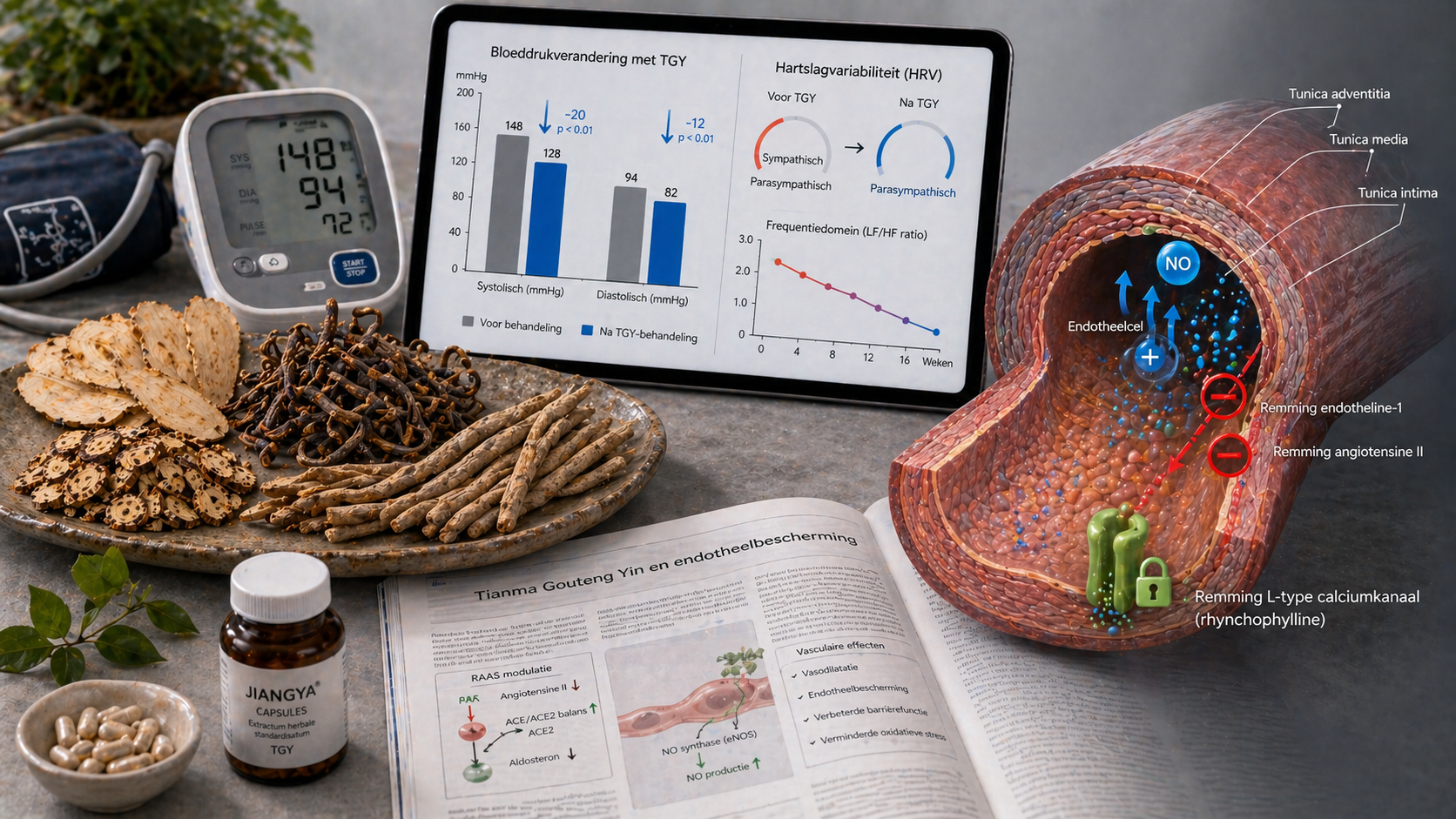
A 2025 meta‑analysis of 22 randomized controlled trials with 2,146 patients with essential hypertension (grade 1‑2) showed that TGY plus standard antihypertensives reduced systolic blood pressure by an additional 8.7 mmHg (95% CI −10.2 to −7.2) and diastolic blood pressure by 5.9 mmHg (95% CI −7.1 to −4.7) compared to standard therapy alone. The response rate (BP <140/90) was 76% in the TGY group vs 58% in controls (RR 1.31, 95% CI 1.18‑1.45). There were no significant differences in adverse events.
Other formulas: Jiangya Capsules and Qiju Dihuang Pill
Jiangya capsules (a standardized product of Uncaria, Cassia, Prunella, etc.) were compared with losartan in a Chinese multicenter RCT (2024, n=480). After 12 weeks, the blood pressure reduction was non‑inferior (SBP −12.2 vs −11.8 mmHg), with less cough as a side effect (1.2% vs 6.7%). Qiju Dihuang Pill (Qi Ju Di Huang Wan) is used mainly in elderly patients with yin‑deficiency hypertension; a study showed improvement in arterial stiffness (reduced pulse wave velocity).
Mechanisms: RAAS inhibition and endothelial protection
Preclinical studies have identified the following mechanisms:
• **RAAS inhibition**: TGY lowers plasma renin activity and angiotensin II, and increases ACE2 activity (the counter‑regulatory enzyme).
• **Endothelial function**: TGY increases NO availability by upregulating eNOS and inhibits endothelin‑1 expression, leading to better vasodilation.
• **Calcium channel modulation**: Some constituents of Uncaria (rhynchophylline) block L‑type calcium channels, similar to dihydropyridines.
• **Oxidative stress**: The formula reduces superoxide anion formation and NADPH oxidase activity in the vessel wall.
• **Autonomic regulation**: TGY modulates sympathetic‑vagal balance (reduced sympathetic tone measured by heart rate variability).
Position in Chinese guidelines
The Chinese Guideline for the Prevention and Treatment of Hypertension (2024) recommends TGY as add‑on therapy for patients with grade 1‑2 hypertension who respond insufficiently to monotherapy, particularly for the TCM pattern ''rising liver‑yang'' (headache, dizziness, flushes). This is a class IIa, level B recommendation.
Conclusion for clinical practice
For Western clinicians: consider adding Tianma Gouteng Yin (standardized extract) for 8‑12 weeks in a hypertensive patient with blood pressure 140‑159/90‑99 mmHg that does not sufficiently decrease on monotherapy. Consult a TCM practitioner for pattern diagnosis (liver‑yang, yin deficiency, or phlegm‑heat). Current evidence – including meta‑analyses and mechanistic studies – supports an integrated approach.