Introduction: why TCM for CKD?
Chronic kidney disease (CKD) is a growing global health problem with high morbidity and mortality. Current treatments (ACE inhibitors, SGLT2 inhibitors) slow progression, but many patients still develop end‑stage renal disease. In China, TCM formulas have been used for centuries for ''kidney essence deficiency'' and ''dampness‑stasis'' patterns. The best‑studied formulas are Niaoduqing Granules (NDQ) and Shenyan Shu Tablets (SYS). This review summarizes clinical evidence and mechanisms.
Clinical studies: Niaoduqing Granules (NDQ)
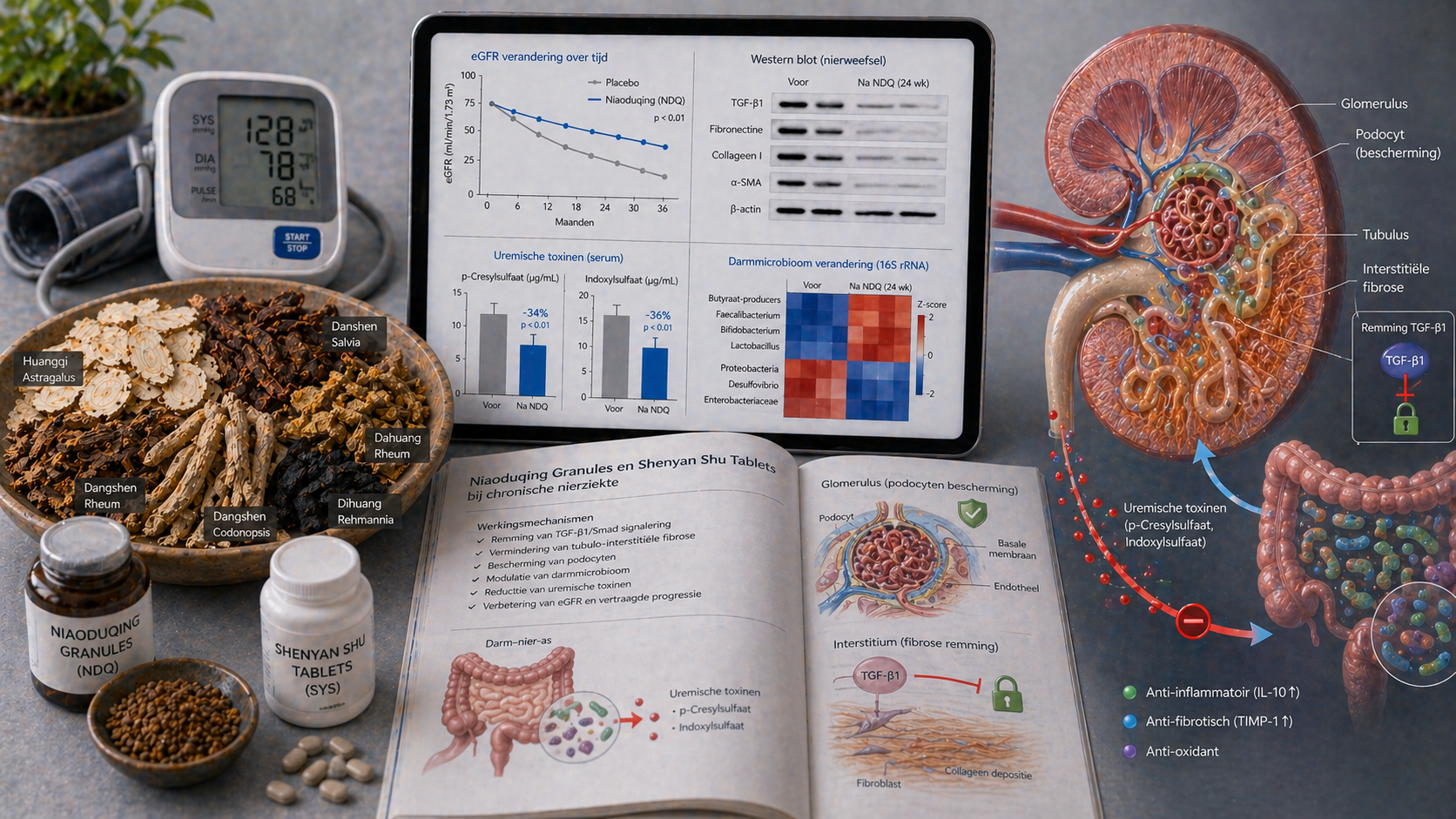
A 2025 meta‑analysis of 18 RCTs with 1,682 CKD patients (stages 3‑4) showed that NDQ plus standard care (ACEi/ARB) slowed the decline in estimated glomerular filtration rate (eGFR) by a mean of 3.2 ml/min/1.73 m² per year (95% CI 2.1–4.3) and lowered serum creatinine (MD −0.28 mg/dL, 95% CI −0.39 to −0.17). Progression to end‑stage renal disease (dialysis or transplantation) was reduced by 38% (RR 0.62, 95% CI 0.48–0.80). Quality of life (KDQOL‑36) improved significantly.
A Chinese multicenter RCT (2024, n=480) with NDQ in CKD stage 4 (eGFR 15‑29 ml/min) showed after 48 weeks a smaller eGFR decline (−2.1 vs −5.4 ml/min/1.73 m², p<0.01) and 22% of NDQ patients had stabilization or improvement of eGFR vs 8% in the placebo group.
Shenyan Shu Tablets (SYS) and other formulas
Shenyan Shu Tablets (Astragalus, Salvia, Rehmannia, etc.) are used mainly in CKD with proteinuria. A meta‑analysis of 12 studies (n=1,024) showed that SYS plus standard care reduced 24‑hour proteinuria (MD −0.65 g/24h, 95% CI −0.88 to −0.42) and stabilized eGFR. Kangxianling Decoction is used for renal fibrosis; an animal study showed inhibition of TGF‑β1 and collagen deposition.
Mechanisms: anti‑fibrotic, anti‑oxidative, and the gut‑kidney axis
Preclinical studies in CKD rats and human kidney cells identified:
• **TGF‑β1/Smad3 inhibition**: NDQ downregulates TGF‑β1 and phospho‑Smad3, reduces fibronectin and collagen I expression, and inhibits tubulointerstitial fibrosis.
• **Oxidative stress**: NDQ increases Nrf2 and superoxide dismutase (SOD), lowers malondialdehyde (MDA) and NADPH oxidase.
• **Gut‑kidney axis**: NDQ modulates gut microbiota (increases butyrate producers, decreases uremia‑producing bacteria), lowers p‑cresyl sulfate and indoxyl sulfate (uremic toxins).
• **Podocyte protection**: SYS inhibits podocyte apoptosis via the PI3K/Akt pathway.
Position in Chinese guidelines
The Chinese Guideline for the Diagnosis and Treatment of Chronic Kidney Disease (2024) recommends NDQ as add‑on therapy for CKD stage 3‑4, especially for the TCM pattern ''dampness‑stasis'' (class IIa, level B). SYS is recommended for proteinuria with the pattern ''qi‑yin deficiency with blood stasis''. The guideline emphasizes that TCM is not a replacement for standard care but adds value.
Conclusion for clinical practice
For Western clinicians: consider adding Niaoduqing Granules to standard care (ACEi/ARB + SGLT2 inhibitor) for patients with CKD stage 3‑4 and progressive eGFR decline (>3 ml/min/year), for at least 6 months. Consult a TCM practitioner for pattern diagnosis (dampness‑stasis, qi‑yin deficiency). Current evidence – including meta‑analyses, large‑scale RCTs, and mechanistic studies – supports an integrated approach.