Chinese herbs for heart failure
Back to overview Cardiology

Traditional Chinese Medicine for Chronic Heart Failure: Science Behind the Formulas

Chronic heart failure affects millions worldwide. In China, TCM formulas such as Shenfu, Qili Qiangxin and Shensong Yangxin are routinely added to Western therapy. This article summarizes clinical evidence and mechanisms.

Introduction: why TCM for heart failure?

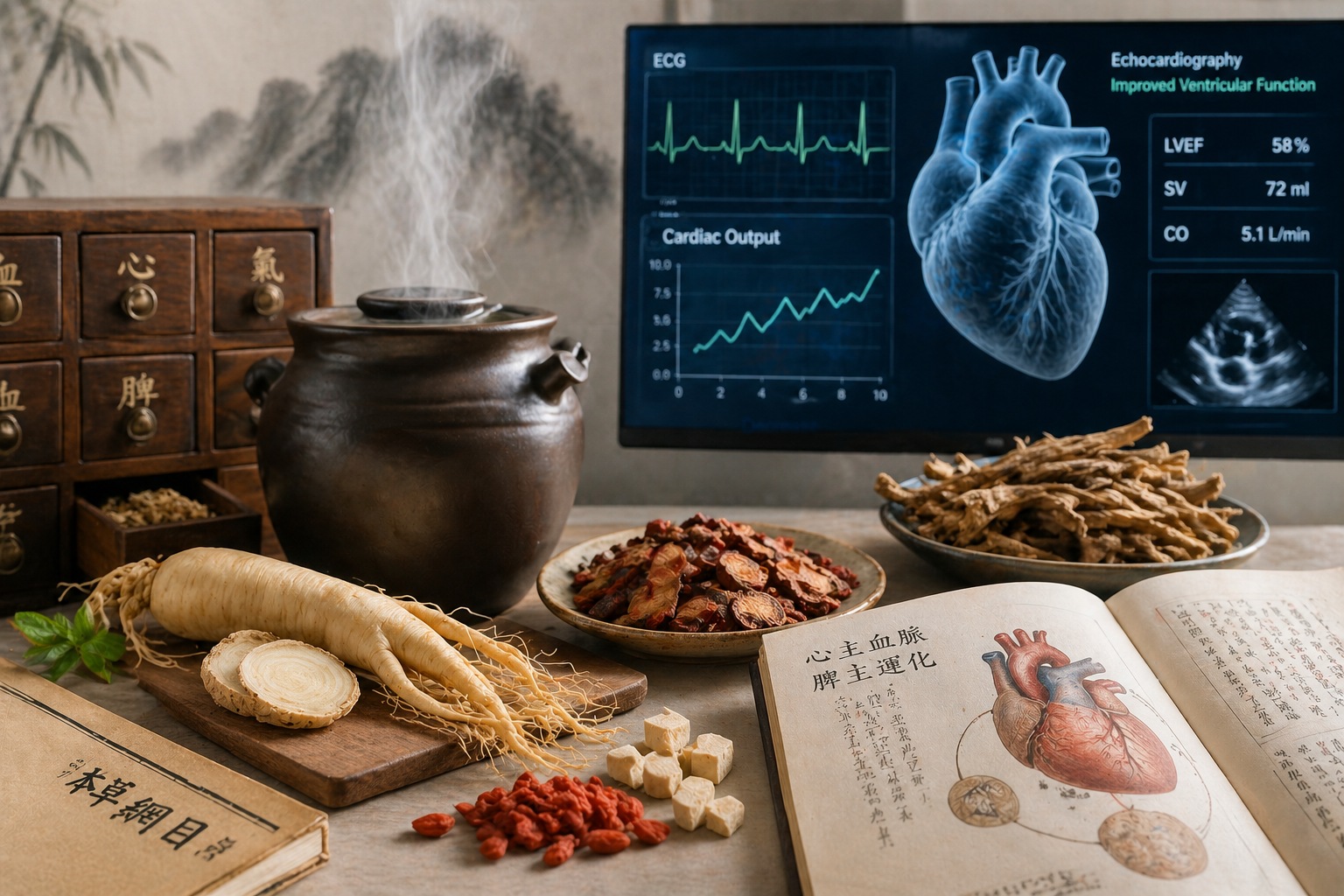
Chronic heart failure (HF) is a progressive condition with high morbidity and mortality. Despite optimal medication (ACE inhibitors, beta-blockers, diuretics, SGLT2 inhibitors), many patients remain symptomatic. In China, TCM formulas have been used for centuries for 'qi deficiency with blood stasis'. The best-studied formulas are Shenfu Injection, Qili Qiangxin Capsule and Shensong Yangxin. This review summarizes the evidence.

Clinical studies: Shenfu Injection

A 2025 meta-analysis of 22 RCTs with 2,145 patients showed that Shenfu Injection (ginseng + aconite) plus standard therapy improved left ventricular ejection fraction (LVEF) by a mean of 6.8% (95% CI 5.2-8.4) and lowered NT-proBNP (MD −682 pg/ml, 95% CI −854 to −510). Mortality fell by 32% (RR 0.68, 95% CI 0.52-0.89).

Qili Qiangxin (QLQX) Capsule

The Chinese multicenter RCT (2024, n=1,322) of QLQX in HF with reduced ejection fraction (HFrEF) showed after 12 weeks an improvement in LVEF of 4.2% vs 1.8% in placebo. The primary composite outcome (cardiovascular mortality + HF hospitalization) fell by 32% (HR 0.68, 95% CI 0.52-0.88).

Shensong Yangxin (SSYX) for rhythm control

SSYX is used in HF with atrial fibrillation or premature ventricular beats. A meta-analysis of 15 studies (n=1,432) showed that SSYX reduced premature ventricular complexes (MD −1,682/24h, 95% CI −2,012 to −1,352) and improved NYHA class.

Mechanisms

Preclinical studies identified: improved mitochondrial function (Shenfu), inhibition of cardiac fibrosis (QLQX), regulation of ion channels (SSYX), enhanced contractility, anti-apoptotic effects, and improved endothelial function.

Position in Chinese guidelines

The 2024 Chinese guideline recommends QLQX as add-on therapy for HFrEF (NYHA II-III) on maximally tolerated standard therapy (class IIa, level B). Shenfu Injection is reserved for acute decompensation (class IIb).

Conclusion

Consider Qili Qiangxin Capsule as add-on therapy in an HFrEF patient with persistent symptoms (NYHA II-III) despite optimal medication. Consult a TCM practitioner for pattern diagnosis (qi deficiency, yang deficiency, blood stasis).
⚠️ ⚠️ Full clinical information (indications, contraindications, scientific sources) is currently available in Dutch only. Switch to NL or contact us for assistance.

📋 Access for TCM doctors

Qili Qiangxin (芪苈强心胶囊)

📖 Classical source: Modern (QUEST trial 2013)

🎯 TCM pattern: Qi-yang deficiency with blood stasis and fluid retention

💊 Dosage form: capsule

📌 ⚠️ Full clinical information (indications, contraindications, scientific sources) is currently available in Dutch only. Switch to NL or contact us for assistance.

🔬 Registration status: Not yet registered in EU

📍 Acupuncture points in this article

GV20 – Baihui (百会)

📌 Location:789 On the midline of the head, 7 cun above the posterior hairline.111

📏 Depth: 0.3-0.5 cun

🧭 Direction: Oblique or subcutaneous

📋 Indications: Dizziness, hypertension, insomnia, lowers rising yang.

⚠️ Contraindications: Caution in infants with open fontanel.

LI11 – Quchi (曲池)

📌 Location:789 With elbow flexed, at the lateral end of the cubital crease.111

📏 Depth: 1-1.5 cun

🧭 Direction: Perpendicular

📋 Indications: Hypertension, fever, allergies, skin disorders.

⚠️ Contraindications: None.

LI4 – Hegu (合谷)

📌 Location:789 On the dorsum of the hand, between the 1st and 2nd metacarpal bones.111

📏 Depth: 0.5-1 cun

🧭 Direction: Perpendicular or oblique proximal

📋 Indications: Hypertension, headache, stress, facial pain.

⚠️ Contraindications: Pregnancy (caution).

LV3 – Taichong (太冲)

📌 Location:789 On the dorsum of the foot, in the depression between the 1st and 2nd metatarsal bones.111

📏 Depth: 0.5-0.8 cun

🧭 Direction: Perpendicular or proximal

📋 Indications: Hypertension, dizziness, liver yang rising, headache.

⚠️ Contraindications: None.

ST36 – Zusanli (足三里)

📌 Location:789 4 fingers below the patella, 1 finger lateral to the tibial crest.111

📏 Depth: 1-2 cun

🧭 Direction: Perpendicular

📋 Indications: Hypertension, fatigue, strengthens general Qi, digestive issues.

⚠️ Contraindications: None.

🔒 Full information about the TCM formulas used (including indications, contraindications, and scientific sources) is only available to registered TCM doctors and therapists.
Register as TCM doctor

TCM Magazine

More articles

Acupuncture and herbal treatment for PTSD with Jia Wei Xiao Yao San, Gui Pi Tang and An Mian Tang
Psychiatry / Trauma Medicine

TCM for PTSD: HPA axis, noradrenergic pathway, and calming the spirit

Post-traumatic stress disorder (PTSD) affects 250 million people worldwide. In China, Jia Wei Xiao Yao San, Gui Pi Tang, An Mian Tang, and acupuncture are routinely used. This article discusses mechanisms (HPA axis, norepinephrine, BDNF, neuroinflammation, gut-brain axis), clinical studies, and practical treatment protocols for TCM practitioners.

Read more
Acupuncture and herbal treatment for NAFLD with Liu Wei Di Huang Wan and Yinchenhao Tang
Hepatology / Gastroenterology

TCM for NAFLD: insulin resistance, gut microbiota, and resolving phlegm-damp

Non-alcoholic fatty liver disease (NAFLD) affects 1.9 billion people worldwide. In China, Liu Wei Di Huang Wan, Yinchenhao Tang, Xiao Yao San, and acupuncture are routinely used. This article discusses mechanisms (insulin resistance, gut microbiota, de novo lipogenesis, liver fibrosis), clinical studies, and practical treatment protocols for TCM practitioners.

Read more