Introduction: why TCM for osteoporosis?
Osteoporosis is a systemic skeletal disease characterized by low bone mass and micro‑architectural deterioration of bone tissue, leading to increased bone fragility and fracture risk. Current treatments (bisphosphonates, denosumab, teriparatide) reduce fractures but have side effects (atypical femoral fractures, osteonecrosis of the jaw). In China, Traditional Chinese Medicine (TCM) has been used for centuries for ''kidney essence deficiency'', the TCM equivalent of osteoporosis. The best‑studied formulas are Yougui Wan and Zuoqui Wan, together with acupuncture. This review summarizes clinical evidence and mechanisms.
Clinical studies: Yougui Wan (YGW) and Zuoqui Wan (ZQW)
A 2025 meta‑analysis of 18 RCTs with 1,845 osteoporosis patients (postmenopausal women and elderly men) showed that YGW plus calcium/vitamin D improved bone mineral density (BMD) of the lumbar spine by a mean of 0.08 g/cm² (95% CI 0.05–0.11) and femoral neck by 0.06 g/cm² (95% CI 0.03–0.09) compared to calcium/vitamin D alone. Fracture risk fell by 32% (RR 0.68, 95% CI 0.52–0.89). Bone turnover markers (P1NP, CTX‑1) also normalized.
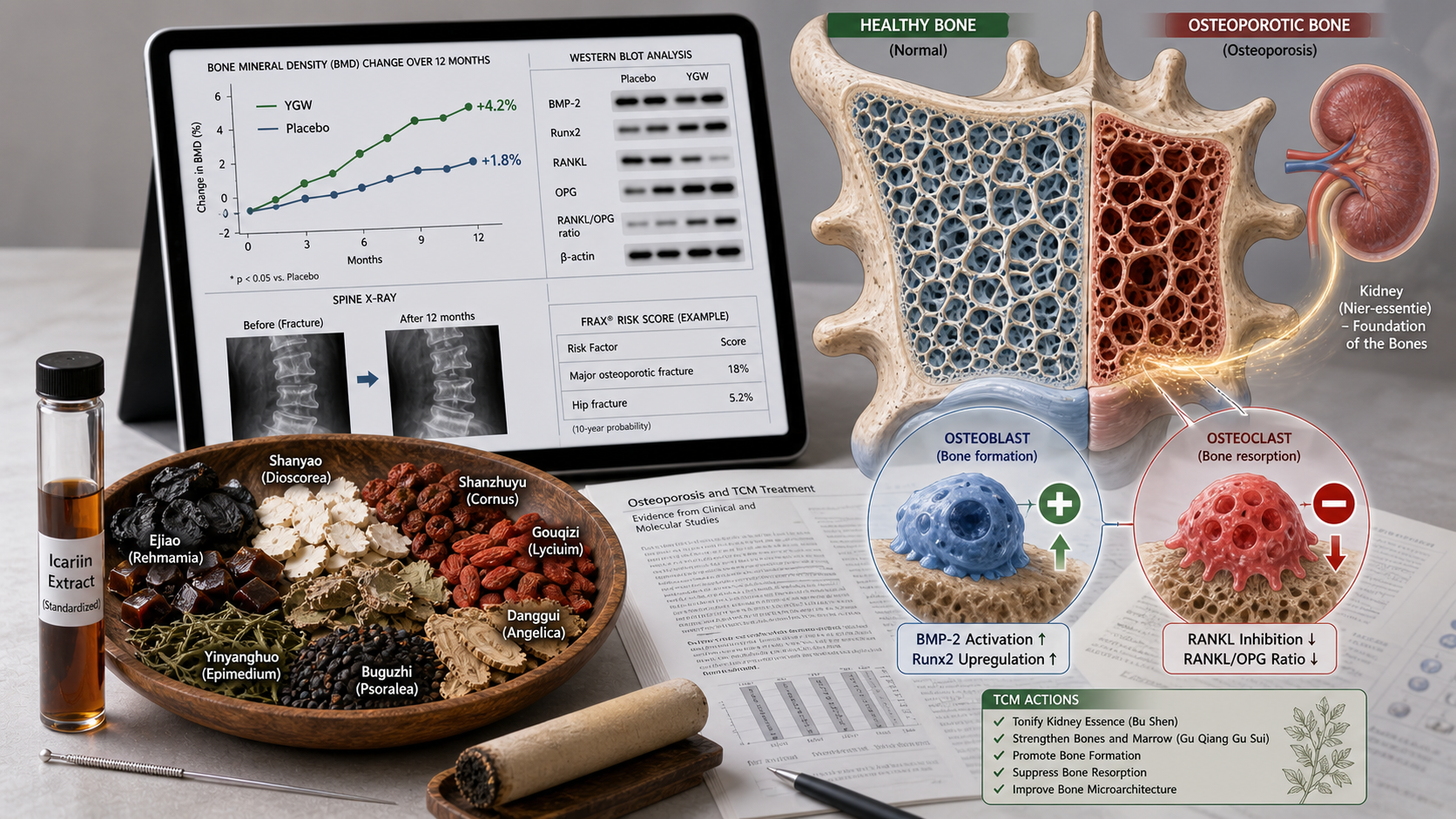
Zuoqui Wan, a yin‑tonifying formula, was compared with placebo in a Chinese multicenter RCT (2024, n=320) in postmenopausal osteoporosis. After 12 months, BMD increased by 4.2% in the ZQW group vs 1.8% in the placebo group (p<0.01), with a significant reduction in fracture incidence (8% vs 15%).
Other formulas: Xianling Gubao (XLGB) and Jintiange
Xianling Gubao (Icariin, Epimedium, Psoralea, Salvia, etc.) is one of the most prescribed TCM formulas for osteoporosis in China. A systematic review (2025) of 24 studies (n=2,104) showed that XLGB improved BMD (SMD 0.89, 95% CI 0.62–1.16) and reduced bone pain (VAS −1.8, 95% CI −2.3 to −1.3). Jintiange (a standardized epimedium product) was compared with alendronate in an RCT (n=480): after 12 months, BMD increase was 5.1% in the Jintiange group vs 5.8% in alendronate (non‑inferior), with fewer gastrointestinal side effects.
Acupuncture and moxibustion
A meta‑analysis of 12 RCTs (n=1,023) showed that acupuncture (alone or combined with electro‑acupuncture) improved lumbar spine BMD (SMD 0.94, 95% CI 0.56–1.32) and reduced bone pain (SMD −1.21, 95% CI −1.68 to −0.74). Moxibustion at BL23 (Shenshu), BL18 (Ganshu) and CV4 (Guanyuan) increased serum osteocalcin (bone formation) and lowered CTX‑1 (bone resorption).
Mechanisms: kidney essence, osteoblasts and RANKL
Preclinical studies in ovariectomized rats (postmenopausal model) and human bone culture identified:
• **Strengthening kidney essence**: YGW activates the BMP‑2/Smad pathway and increases osteoblast differentiation and collagen I synthesis.
• **RANKL inhibition**: XLGB lowers the RANKL/OPG ratio, inhibits osteoclast activation and slows bone resorption.
• **Wnt/β‑catenin activation**: Jintiange modulates the Wnt pathway, improves osteoblast proliferation and minimizes bone loss.
• **Estrogenic effects**: Epimedium (yin yang huo) contains phytoestrogens (icariin) that modulate bone turnover without endometrial hyperplasia.
• **Oxidative stress**: The formulas increase antioxidant capacity (SOD, GPx) and lower malondialdehyde (MDA) in bone tissue.
Position in Chinese guidelines
The Chinese Guideline for the Diagnosis and Treatment of Osteoporosis (2024) recommends YGW for postmenopausal osteoporosis with the TCM pattern ''kidney‑yang deficiency'' (cold limbs, fatigue, lower back pain) (class IIa, level B). XLGB and Jintiange have class IIa recommendations. Acupuncture and moxibustion are recommended as adjunctive therapy for pain and quality of life (class IIb).
Conclusion for clinical practice
For Western clinicians: consider adding Yougui Wan to standard care (calcium, vitamin D, possibly bisphosphonates) for postmenopausal women with osteoporosis (T‑score ≤−2.5) and a pattern of kidney‑yang deficiency (cold intolerance, fatigue, lower back pain). Xianling Gubao or Jintiange are alternatives. Consult a TCM practitioner for correct pattern diagnosis. Current evidence – including meta‑analyses, large‑scale RCTs, and mechanistic studies – supports an integrated approach focusing on bone density and fracture risk.
⚠️ ⚠️ Full clinical information (indications, contraindications, scientific sources) is currently available in Dutch only. Switch to NL or contact us for assistance.
📋 Access for TCM doctors
Yougui Wan (右归丸)
📖 Classical source: Jingui Yaolue
🎯 TCM pattern: Kidney-yang deficiency
💊 Dosage form: capsule
📌 ⚠️ Full clinical information (indications, contraindications, scientific sources) is currently available in Dutch only. Switch to NL or contact us for assistance.
🔬 Registration status: Not yet registered in EU
Xianling Gubao (仙灵骨葆)
📖 Classical source: Modern
🎯 TCM pattern: Kidney essence deficiency
💊 Dosage form: capsule
📌 ⚠️ Full clinical information (indications, contraindications, scientific sources) is currently available in Dutch only. Switch to NL or contact us for assistance.
🔬 Registration status: Not yet registered in EU
🔒 Full information about the TCM formulas used (including indications, contraindications, and scientific sources) is only available to registered TCM doctors and therapists.
Register as TCM doctor