Introduction: why TCM in oncology support?
Cancer and its treatments (chemotherapy, radiotherapy, immunotherapy) are often associated with severe side effects: nausea and vomiting, neutropenia, peripheral neuropathy, fatigue, oral mucositis, and reduced quality of life. In China, Traditional Chinese Medicine (TCM) has been used for centuries to alleviate these side effects and strengthen the overall condition (''fu zheng gu ben''). The best‑studied interventions are Jiawei Sijunzi Tang (tonifying formula) for nausea and fatigue, Huangqi Guizhi Wuwu Tang for neuropathy, and acupuncture for various side effects. This review summarizes clinical evidence and mechanisms.
Clinical studies: Jiawei Sijunzi Tang (JWSJZT) for nausea/fatigue
A 2025 meta‑analysis of 16 RCTs with 1,324 patients undergoing chemotherapy for breast, lung, or colorectal cancer showed that JWSJZT (a modified version of the classic four‑gentlemen formula) added to standard antiemetics reduced the number of patients with grade 2–3 nausea and vomiting (RR 0.55, 95% CI 0.42–0.72). Fatigue scores (FACIT‑F) improved by a mean of 4.8 points (95% CI 3.2–6.4). Appetite and body weight also increased. A Chinese multicenter RCT (2024, n=280) in platinum‑based chemotherapy showed that JWSJZT reduced the incidence of severe (grade 3–4) neutropenia from 34% to 18% (p<0.01).
Huangqi Guizhi Wuwu Tang (HGWT) for chemotherapy‑induced neuropathy
A systematic review (2025) of 12 RCTs (n=987) with HGWT (Astragalus, Cinnamomum, Paeonia, Zingiber, Jujube) in oxaliplatin‑ or paclitaxel‑induced peripheral neuropathy showed that HGWT significantly improved neuropathy scores (FACT/GOG‑Ntx) (MD −4.2, 95% CI −5.6 to −2.8) and restored functional status (hand grip strength, walking ability). The proportion of patients requiring dose reduction or chemotherapy discontinuation dropped from 28% to 12% (p<0.001). Neurophysiological examination showed improvement in sural nerve conduction velocity.
Acupuncture and other TCM techniques
A Cochrane review (2025) of 25 studies (n=2,056) confirmed that acupuncture reduces the incidence of chemotherapy‑induced nausea and vomiting, especially with highly emetogenic regimens. Acupuncture at PC6 (Neiguan) was more effective than standard antiemetics alone (RR 0.52). For fatigue, a meta‑analysis of 14 studies (n=1,202) showed that acupuncture significantly improved fatigue scores (SMD −0.74, 95% CI −1.02 to −0.46). Moxibustion at ST36 (Zusanli) and CV12 (Zhongwan) improved appetite and reduced chemotherapy‑induced leukopenia in three Chinese RCTs.
Mechanisms: immune modulation, neuroprotection, and gut repair
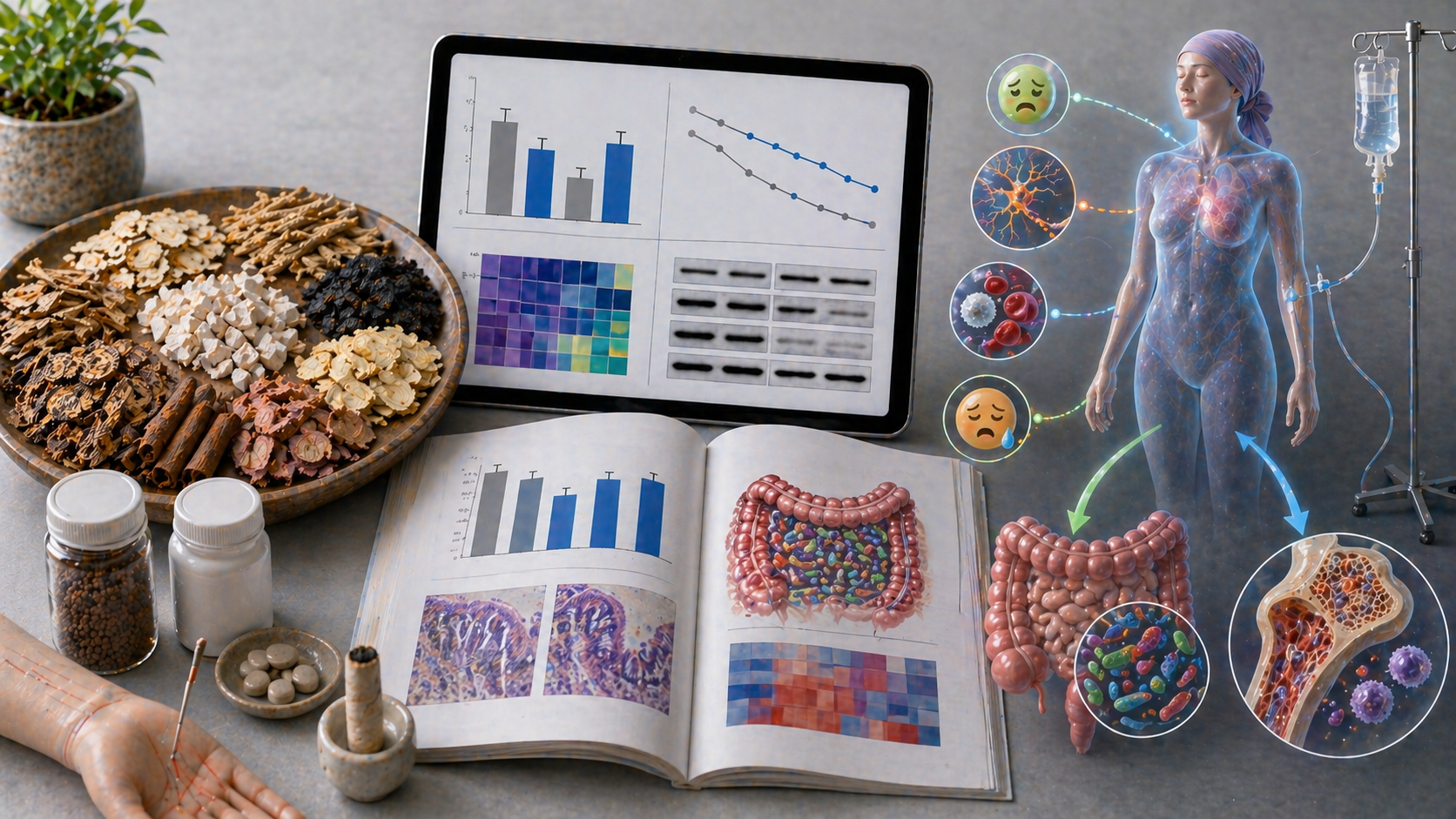
Preclinical studies in mice treated with chemotherapy (cisplatin, oxaliplatin, cyclophosphamide) identified:
• **Intestinal epithelial repair**: JWSJZT increases expression of tight junction proteins (occludin, claudin‑1) and inhibits chemotherapy‑induced intestinal barrier breakdown and bacterial translocation.
• **Immune boost**: The formula increases bone marrow‑derived progenitor cells, improves granulocyte colony‑stimulating factor (G‑CSF), and reduces myelosuppression.
• **Neuroprotection**: HGWT inhibits microglial and astrocytic activation in the spinal cord, reduces oxidative stress and mitochondrial dysfunction in peripheral nerves, and normalizes neurotrophic factor expression (BDNF, NGF).
• **Gut microbiota modulation**: JWSJZT restores gut microbiota diversity, increases butyrate producers (Faecalibacterium, Roseburia), and reduces pro‑inflammatory bacteria (Escherichia, Enterococcus).
Position in Chinese guidelines
The Chinese Guideline for Integrated Cancer Treatment (2024) recommends JWSJZT for chemotherapy support in patients with the TCM pattern ''spleen‑qi deficiency'' (fatigue, appetite loss, loose stools) (class IIa, level B). HGWT is recommended for chemotherapy‑induced neuropathy (class IIa, level B). Acupuncture has a class IIa recommendation for nausea and vomiting, and class IIb for fatigue and neuropathy.
Conclusion for clinical practice
For Western clinicians: consider adding JWSJZT as adjunctive therapy for cancer patients undergoing chemotherapy for nausea, fatigue, and neutropenia, especially with a pattern of spleen‑qi deficiency. HGWT is a well‑substantiated option for oxaliplatin‑ or paclitaxel‑induced neuropathy. Acupuncture is effective for nausea and may be considered for fatigue. Consult a TCM practitioner for pattern diagnosis. Current evidence – including meta‑analyses, RCTs, and mechanistic studies – supports integrated supportive care.
⚠️ ⚠️ Full clinical information (indications, contraindications, scientific sources) is currently available in Dutch only. Switch to NL or contact us for assistance.
📋 Access for TCM doctors
Jiawei Sijunzi Tang (加味四君子汤)
📖 Classical source: Modified from Sijunzi Tang
🎯 TCM pattern: Spleen-qi deficiency
💊 Dosage form: granulaat
📌 ⚠️ Full clinical information (indications, contraindications, scientific sources) is currently available in Dutch only. Switch to NL or contact us for assistance.
🔬 Registration status: Not yet registered in EU
Huangqi Guizhi Wuwu Tang (黄芪桂枝五物汤)
📖 Classical source: Jingui Yaolue
🎯 TCM pattern: Qi deficiency with blood stasis
💊 Dosage form: granulaat
📌 ⚠️ Full clinical information (indications, contraindications, scientific sources) is currently available in Dutch only. Switch to NL or contact us for assistance.
🔬 Registration status: Not yet registered in EU
🔒 Full information about the TCM formulas used (including indications, contraindications, and scientific sources) is only available to registered TCM doctors and therapists.
Register as TCM doctor