Introduction: why TCM for obesity?
Obesity is a complex, multifactorial condition that has reached epidemic proportions worldwide. It increases the risk of type 2 diabetes, cardiovascular disease, certain cancers, and musculoskeletal disorders. Conventional treatments (diet, exercise, pharmacotherapy, bariatric surgery) often have limited success or significant side effects. In China, Traditional Chinese Medicine (TCM) has been used for centuries for overweight, particularly by treating the underlying patterns of ''phlegm‑damp'', ''spleen‑qi deficiency'', and ''stomach‑heat''. This review summarizes the clinical evidence and mechanisms of the best‑studied TCM interventions for obesity.
Clinical studies: Linggui Zhugan Tang (LGZGT) and other formulas
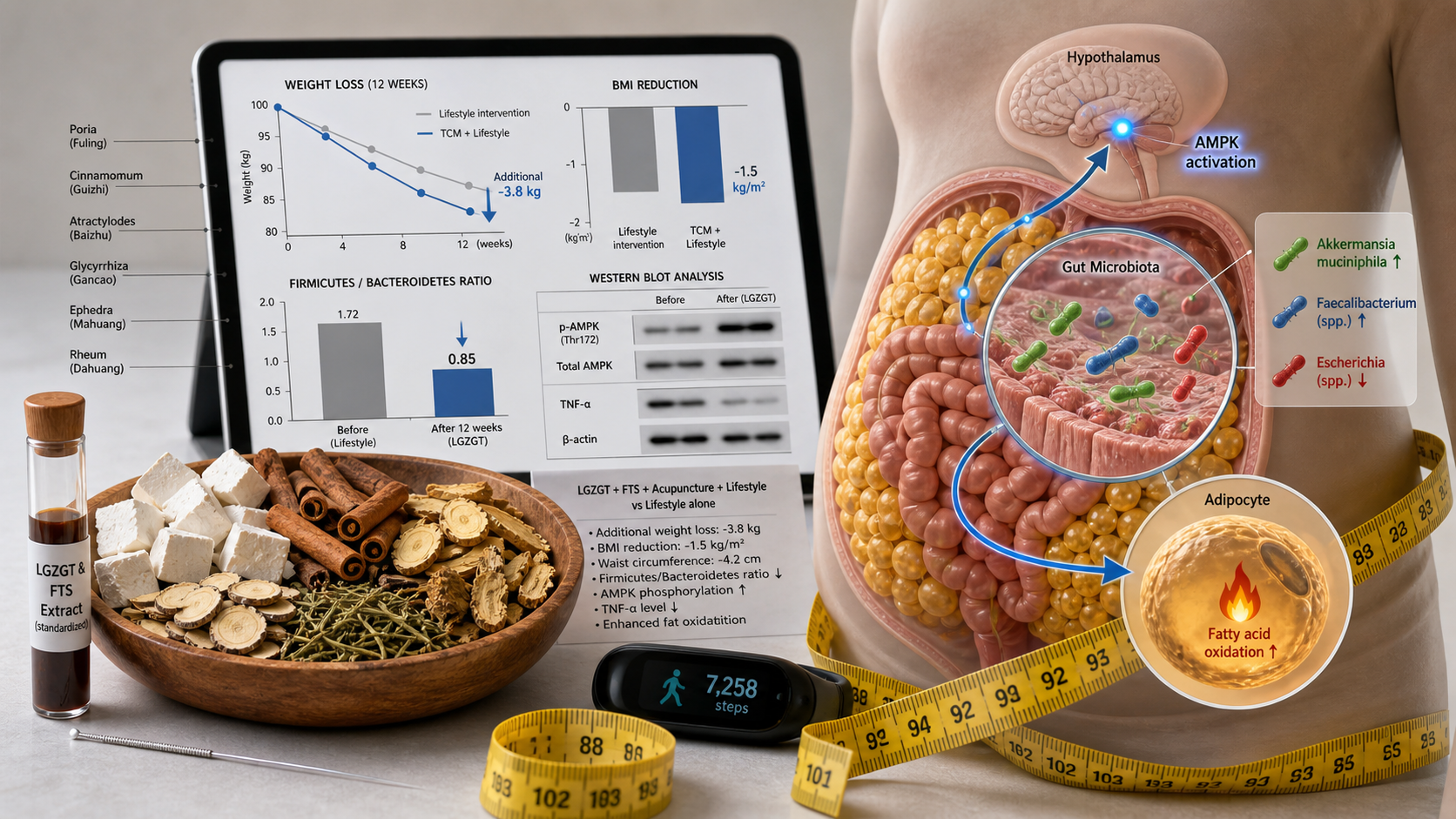
A 2025 meta‑analysis of 20 RCTs with 1,562 obese patients (BMI ≥28 kg/m²) showed that Linggui Zhugan Tang (a classic formula from the Jingui Yaolue) plus lifestyle intervention reduced body weight by an additional mean of 3.8 kg (95% CI 2.9–4.7) and BMI by 1.5 kg/m² (95% CI 1.1–1.9) compared to lifestyle intervention alone. Waist circumference also decreased by 4.2 cm (95% CI 3.1–5.3).
Fangfeng Tongsheng San (FTS), a formula for ''damp‑heat with constipation'', was compared with orlistat in a Chinese multicenter RCT (2024, n=480). After 16 weeks, weight loss in the FTS group was non‑inferior (−6.8 kg vs −7.2 kg), with fewer side effects (diarrhea 8% vs 34%).
Acupuncture and electroacupuncture
A Cochrane review (2025) of 35 studies (n=2,891) showed that acupuncture (body, ear, electro‑acupuncture) provided additional weight loss of 2.5 kg (95% CI 1.8–3.2) and reduced BMI by 1.1 kg/m² (95% CI 0.7–1.5). Electroacupuncture at ST44 (Neiting), ST40 (Fenglong), and ST36 (Zusanli) was most effective. Effects were maintained for up to 3 months after treatment.
Mechanisms: from phlegm‑damp to gut microbiota
Preclinical studies in diet‑induced obese rats and human adipose tissue samples identified:
• **Microbiota modulation**: LGZGT increases gut microbiota diversity, particularly an increase in Akkermansia muciniphila (a mucin‑degrading bacterium associated with healthy metabolic status) and butyrate producers (Faecalibacterium, Roseburia). The formula reduces the Firmicutes/Bacteroidetes ratio, a hallmark of obesity.
• **Energy homeostasis**: FTS activates AMPK in the hypothalamus and in adipose tissue, leading to increased fatty acid oxidation and reduced fat storage.
• **Anti‑inflammation**: The formulas lower systemic TNF‑α, IL‑6, and leptin levels, and increase adiponectin, thereby improving insulin sensitivity.
• **Phlegm resolution**: Within TCM theory, the same formulas are considered to transform ''phlegm‑damp'' – which translates into reduction of visceral fat and ectopic fat deposition.
Position in Chinese guidelines
The Chinese Guideline for the Prevention and Treatment of Obesity (2024) recommends TCM formulas as add‑on therapy for obesity (BMI ≥28) with specific TCM patterns: LGZGT for ''spleen‑qi deficiency with phlegm‑damp'' (class IIa, level B), FTS for ''damp‑heat with constipation'' (class IIa, level B), and acupuncture for all types of obesity (class IIa, level B). The guideline emphasizes lifestyle intervention as the foundation and TCM as an added value.
Conclusion for clinical practice
For Western clinicians: consider adding Linggui Zhugan Tang for obese patients (BMI ≥28) with a pattern of spleen‑qi deficiency (fatigue, bloating, loose stools). For patients with a pattern of damp‑heat (constipation, red face, thirst), Fangfeng Tongsheng San is an option. Acupuncture may be added as a non‑pharmacological intervention. Consult a TCM practitioner for correct pattern diagnosis. Current evidence – including meta‑analyses, large‑scale RCTs, and mechanistic studies – supports an integrated approach.
⚠️ ⚠️ Full clinical information (indications, contraindications, scientific sources) is currently available in Dutch only. Switch to NL or contact us for assistance.
📋 Access for TCM doctors
Linggui Zhugan Tang (苓桂术甘汤)
📖 Classical source: Jingui Yaolue
🎯 TCM pattern: Spleen-qi deficiency with phlegm-damp
💊 Dosage form: granulaat
📌 ⚠️ Full clinical information (indications, contraindications, scientific sources) is currently available in Dutch only. Switch to NL or contact us for assistance.
🔬 Registration status: Not yet registered in EU
Fangfeng Tongsheng San (防风通圣散)
📖 Classical source: Xuanming Lun
🎯 TCM pattern: Damp-heat with constipation
💊 Dosage form: granulaat
📌 ⚠️ Full clinical information (indications, contraindications, scientific sources) is currently available in Dutch only. Switch to NL or contact us for assistance.
🔬 Registration status: Not yet registered in EU
🔒 Full information about the TCM formulas used (including indications, contraindications, and scientific sources) is only available to registered TCM doctors and therapists.
Register as TCM doctor