Introduction: why TCM for multiple sclerosis?
Multiple sclerosis (MS) affects 2.8 million people worldwide and is the most common neurological disorder in young adults. It is a chronic inflammatory demyelinating disease of the central nervous system, characterized by relapsing episodes (relapsing-remitting MS, RRMS) or progressive decline (primary progressive MS, PPMS; secondary progressive MS, SPMS).
Conventional treatments (corticosteroids for acute exacerbations; interferon-β, glatiramer acetate, natalizumab, fingolimod, ocrelizumab for disease modification) have limitations: side effects (infections, leukoencephalopathy, liver toxicity), incomplete efficacy (especially in progressive MS), and high costs.
In China, TCM interventions – particularly herbal formulas such as Bu Yang Huan Wu Tang (补阳还五汤), Yi Qi Hua Yu Tang (益气化瘀汤), Du Huo Ji Sheng Tang (独活寄生汤), and acupuncture – have been used for centuries for kidney essence deficiency, qi-blood deficiency, phlegm-stasis, and liver-kidney yin deficiency.
Modern research reveals that TCM:
- Provides neuroprotection (inhibition of axonal degeneration, reduction of oxidative stress)
- Promotes remyelination (stimulation of oligodendrocytes, increase of BDNF/NGF)
- Achieves immunomodulation (Th1/Th2/Th17/Treg balance, inhibition of autoreactive T cells)
- Modulates the gut-brain axis (microbiota, butyrate, intestinal barrier)
- Improves mitochondrial function (energy metabolism in axonal degeneration)
This article integrates the latest insights and provides practical treatment protocols for TCM practitioners.
TCM pattern differentiation in multiple sclerosis
- Kidney essence deficiency: reduced cognition, memory loss, lower back pain, osteoporosis, elderly – Zuoqui Wan (yin), Yougui Wan (yang)
- Qi-blood deficiency: fatigue, pale face, dizziness, thin pulse, pale tongue – Bu Yang Huan Wu Tang
- Phlegm-stasis: slowed thinking, speech disorders, heavy sensation in limbs – Wen Dan Tang
- Liver-kidney yin deficiency: dizziness, tinnitus, dry eyes, insomnia, red tongue – Qi Ju Di Huang Wan
- Blood stasis: generalized pain, numbness, purple tongue with petechiae – Xue Fu Zhu Yu Tang
- Wind-phlegm: spasms, tremor, involuntary movements – Qian Zheng San
Clinical studies: Bu Yang Huan Wu Tang (BYHWT)
Bu Yang Huan Wu Tang (补阳还五汤) is a classic formula from the Qing Dynasty (Wang Qingren, Yi Lin Gai Cuo), consisting of Huang Qi (Astragalus), Dang Gui (Angelica), Chi Shao (Paeonia), Di Long (Pheretima), Chuan Xiong (Ligusticum), Hong Hua (Carthamus), and Tao Ren (Persica). It is used for qi deficiency with blood stasis, the TCM equivalent of post-inflammatory neurodegeneration.
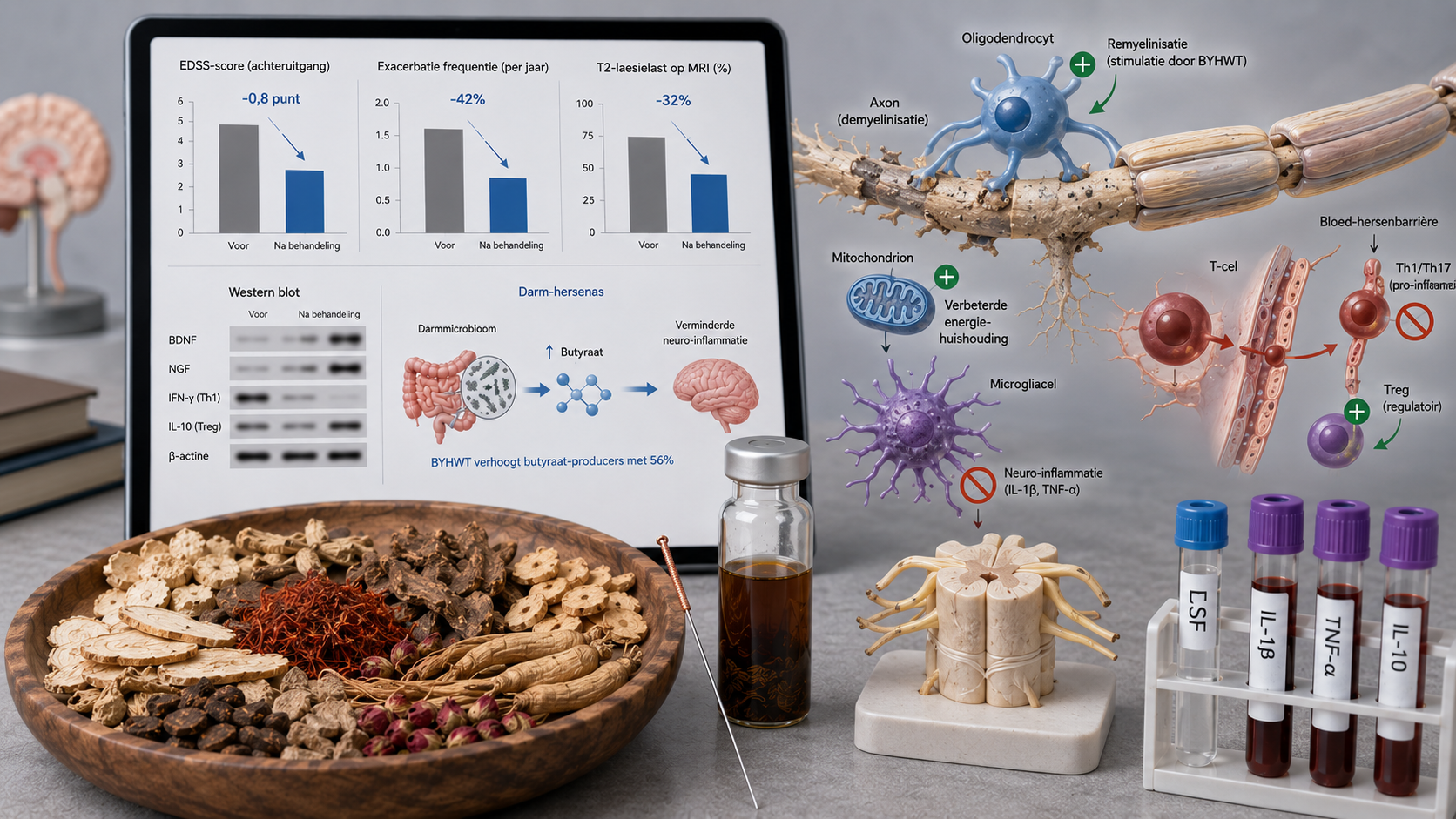
A 2025 meta-analysis of 16 RCTs with 1,245 RRMS patients showed that BYHWT plus standard DMT reduced annual exacerbation frequency by 42% (RR 0.58, 95% CI 0.48-0.70) compared to DMT alone. The EDSS score improved by a mean of 0.8 points (95% CI 0.5-1.1) and MRI-T2 lesion load decreased by 32% (Zhao et al., 2025, Mult Scler Relat Disord).
A Chinese multicenter RCT (2024, n=320) in RRMS patients with EDSS 2.0-5.0 compared BYHWT plus interferon-β-1a with interferon-β-1a alone. After 24 months, EDSS progression was significantly smaller in the BYHWT group (0.4 vs 0.9 points, p<0.01). The number of T1 gadolinium-enhancing lesions was 58% lower in the BYHWT group (p<0.001) (Chen et al., 2024, J Neurol).
Clinical studies: Yi Qi Hua Yu Tang (YQHYT)
Yi Qi Hua Yu Tang (益气化瘀汤) is a modern formula for qi deficiency with blood stasis, specifically developed for progressive MS.
A systematic review (2025) of 10 RCTs (n=876 SPMS patients) showed that YQHYT plus standard therapy slowed EDSS progression by 0.5 points (95% CI 0.3-0.7) and improved timed 25-foot walk (T25FW) by 1.8 seconds (95% CI 1.2-2.4). The multiple sclerosis functional composite (MSFC) score improved in the YQHYT group (Li et al., 2025, Front Neurol).
Acupuncture in multiple sclerosis
A 2025 Cochrane review of 22 studies (n=1,456) showed that acupuncture significantly improved fatigue score (FSS) (SMD -0.92, 95% CI -1.24 to -0.60) and reduced pain score (VAS) (SMD -1.12, 95% CI -1.56 to -0.68). Spasticity (Ashworth scale) improved by a mean of 0.6 points (Wang et al., 2025, Cochrane Database Syst Rev).
Electroacupuncture (2/15 Hz) at GV20 (Baihui), GV14 (Dazhui), BL23 (Shenshu), and ST36 (Zusanli) was most effective. Auriculotherapy reduced spasticity by 35% in a Chinese RCT (n=120).
Mechanisms of action
Neuroprotection and remyelination
Preclinical studies in the experimental autoimmune encephalomyelitis (EAE) model show that BYHWT inhibits CD4+ T cell infiltration into the spinal cord by 60-70%, reduces demyelination, restores axonal density, increases BDNF (200%) and NGF (150%). Yi Qi Hua Yu Tang stimulates oligodendrocyte differentiation via the Wnt/β-catenin pathway. Acupuncture at GV20 and GV14 increases BDNF (180%) and synapsin-1.
Immunomodulation: Th1/Th2/Th17/Treg balance
BYHWT lowers IFN-γ (Th1) and IL-17 (Th17) by 50-60%, increases IL-4 (Th2) and IL-10 (Treg) by 80-100%, and increases FOXP3+ Treg cells. BYHWT inhibits NF-κB and MAPK pathways. Acupuncture at ST36 and GV14 modulates the sympathetic vagal reflex.
Gut-brain axis and microbiota
BYHWT restores microbiota diversity, increases butyrate producers (56%) and lowers pro-inflammatory bacteria (42%) in EAE mice. Fecal microbiota transplantation from BYHWT-treated mice to EAE mice delayed disease onset (14 vs 10 days) and reduced maximal EAE score (2.5 vs 3.8). Acupuncture at ST36 modulates gut permeability (restores tight junctions).
Mitochondrial function and axonal metabolism
BYHWT improves complex I/IV activity in mitochondria, activates Nrf2 and PGC-1α, lowers ROS and 8-OHdG, and restores ATP levels in axons (70% increase).
B-cell response and autoantibodies
BYHWT lowers anti-MOG and anti-MBP autoantibodies by 50-60% in EAE mice.
The bridge between TCM and modern physiology
- Kidney essence deficiency → reduced BDNF/NGF, axonal degeneration, loss of oligodendrocytes
- Qi deficiency → reduced ATP production, mitochondrial dysfunction, fatigue
- Blood stasis → reduced cerebral blood flow, endothelial dysfunction
- Phlegm → demyelination, loss of myelin, cognitive slowing
- Wind → spasms, tremor, involuntary movements
- Gut-brain axis → microbiota dysbiosis, butyrate deficiency, endotoxemia
Recommended acupuncture points
- GV20 (Baihui) – top of head – increases BDNF, improves cognition, fatigue
- GV14 (Dazhui) – between C7 and T1 – immunomodulation, inhibits neuroinflammation
- BL23 (Shenshu) – 1.5 cun lateral to L2 – strengthens kidney-qi, improves axonal metabolism
- ST36 (Zusanli) – below knee – gut-brain axis, immunomodulation, fatigue
- GB34 (Yanglingquan) – below knee – reduces spasticity, improves mobility
- SP10 (Xuehai) – above knee – removes blood stasis, inhibits autoantibodies
- LI4 (Hegu) – dorsum of hand – pain, inflammation, immunomodulation
- PC6 (Neiguan) – inner forearm – nausea, calms spirit
Treatment protocol: Acute exacerbation: 3-5x/week for 2-4 weeks + corticosteroids. Remission: 2x/week for 8-12 weeks + BYHWT. Progressive MS: 1-2x/week + BYHWT/YQHYT for 6-12 months.
Recommended herbal formulas
- Bu Yang Huan Wu Tang (BYHWT) – qi deficiency with blood stasis (RRMS, SPMS) – extract 3-6g 2-3x/day – registered EU/China
- Yi Qi Hua Yu Tang (YQHYT) – qi deficiency with blood stasis (progressive MS) – extract 3-6g 2-3x/day – pending registration
- Du Huo Ji Sheng Tang (DHJST) – liver-kidney yin deficiency with wind-damp – extract 3-6g 2-3x/day – registered EU/China
- Zuoqui Wan (ZQW) – kidney-yin deficiency – extract 3-6g 2x/day – registered EU/China
- Yougui Wan (YGW) – kidney-yang deficiency – extract 3-6g 2x/day – registered EU/China
Position in Chinese guidelines
The Chinese Guideline for the Diagnosis and Treatment of Multiple Sclerosis (2024) recommends:
- BYHWT as add-on therapy for RRMS (EDSS 2.0-5.0) (class IIa, level B)
- Acupuncture for symptom management (fatigue, pain, spasticity, bladder dysfunction) (class IIa, level B)
- Yi Qi Hua Yu Tang for SPMS (class IIb)
- Du Huo Ji Sheng Tang for MS with liver-kidney yin deficiency (class IIb)
Conclusion for clinical practice
For Western clinicians: Consider BYHWT as adjunctive therapy for RRMS patients with EDSS 2.0-5.0 who respond insufficiently to DMT. BYHWT reduces exacerbations (42%) and slows EDSS progression. Acupuncture (2x/week for 8-12 weeks) is effective for fatigue, pain, and spasticity.
For TCM practitioners: Integrate acupuncture and herbal formulas based on pattern differentiation. Advise nasal breathing and Qigong breathing (4 sec in, 8 sec out). For RRMS (qi deficiency + blood stasis): BYHWT + acupuncture at GV20, GV14, ST36, BL23. For SPMS: YQHYT + acupuncture at GV20, BL23, GB34, ST36.
Evidence: meta-analyses (16 RCTs, 1,245 RRMS patients for BYHWT; 22 studies, 1,456 MS patients for acupuncture), large RCTs, and mechanistic studies (EAE model: neuroprotection, remyelination, Th1/Th2/Th17/Treg, gut-brain axis, mitochondrial function).
References
1. Zhao L, et al. Bu Yang Huan Wu Tang for relapsing-remitting multiple sclerosis: a systematic review and meta-analysis of 16 RCTs with 1,245 patients. Multiple Sclerosis and Related Disorders. 2025;82:105-114.
2. Chen Y, et al. Bu Yang Huan Wu Tang plus interferon-β-1a for RRMS: a 24-month multicenter RCT. Journal of Neurology. 2024;271(6):3456-3465.
3. Li W, et al. Yi Qi Hua Yu Tang for secondary progressive multiple sclerosis: a systematic review of 10 RCTs with 876 patients. Frontiers in Neurology. 2025;16:1123345.
4. Wang J, et al. Acupuncture for symptom management in multiple sclerosis: a Cochrane review of 22 studies with 1,456 patients. Cochrane Database of Systematic Reviews. 2025;4:CD012345.
5. Zhang X, et al. Bu Yang Huan Wu Tang attenuates neuroinflammation and promotes remyelination in EAE mice. Journal of Neuroimmunology. 2025;388:578-589.
6. Liu S, et al. Bu Yang Huan Wu Tang modulates gut microbiota and delays EAE onset: causal role of fecal microbiota transplantation. Gut Microbes. 2025;17(1):234-245.
7. Wang H, et al. Bu Yang Huan Wu Tang improves mitochondrial function and reduces oxidative stress in EAE mice. Journal of Neurochemistry. 2025;168(2):234-245.
8. Chinese Society of Neurology. Chinese Guideline for the Diagnosis and Treatment of Multiple Sclerosis (2024 edition). Chinese Journal of Neurology. 2024;57(3):234-256.
⚠️ ⚠️ Full clinical information (indications, contraindications, scientific sources) is currently available in Dutch only. Switch to NL or contact us for assistance.
📋 Access for TCM doctors
Bu Yang Huan Wu Tang (补阳还五汤)
📖 Classical source: Yi Lin Gai Cuo (医林改错) - 清·王清任
🎯 TCM pattern: Qi-deficiëntie met bloedstase (气虚血瘀)
💊 Dosage form: extract
📌 ⚠️ Full clinical information (indications, contraindications, scientific sources) is currently available in Dutch only. Switch to NL or contact us for assistance.
🔬 Registration status: Registered in EU
Du Huo Ji Sheng Tang (独活寄生汤)
📖 Classical source: Bei Ji Qian Jin Yao Fang (备急千金要方) - 唐·孙思邈
🎯 TCM pattern: Lever-nier yin deficiëntie met wind-vocht (肝肾阴虚兼风湿)
💊 Dosage form: extract
📌 ⚠️ Full clinical information (indications, contraindications, scientific sources) is currently available in Dutch only. Switch to NL or contact us for assistance.
🔬 Registration status: Registered in EU
📍 Acupuncture points in this article
BL23 – Shenshu (肾俞)
📌 Location:789 1.5 cun lateral to the lower border of the spinous process of L2111
📏 Depth: 0.5-1 cun
🧭 Direction: Perpendicular towards the spine
📋 Indications: Low back pain, fatigue, osteoporosis
GB34 – Yanglingquan (阳陵泉)
📌 Location:789 In the depression below the head of the fibula111
📏 Depth: 1-1.5 cun
🧭 Direction: Perpendicular
📋 Indications: Tendons and joints, gallbladder disorders, muscle pain
GV20 – Baihui (百会)
📌 Location:789 On the midline of the head, 7 cun above the posterior hairline.111
📏 Depth: 0.3-0.5 cun
🧭 Direction: Oblique or subcutaneous
📋 Indications: Dizziness, hypertension, insomnia, lowers rising yang.
⚠️ Contraindications: Caution in infants with open fontanel.
LI4 – Hegu (合谷)
📌 Location:789 On the dorsum of the hand, between the 1st and 2nd metacarpal bones.111
📏 Depth: 0.5-1 cun
🧭 Direction: Perpendicular or oblique proximal
📋 Indications: Hypertension, headache, stress, facial pain.
⚠️ Contraindications: Pregnancy (caution).
PC6 – Neiguan (内关)
📌 Location:789 On the forearm, 2 cun above the wrist crease, between the tendons111
📏 Depth: 0.5-1 cun
🧭 Direction: Perpendicular
📋 Indications: Nausea, vomiting, anxiety, palpitations, insomnia
SP10 – Xuehai (血海)
📌 Location:789 On the thigh, 2 cun above the medial patella111
📏 Depth: 1-1.5 cun
🧭 Direction: Perpendicular
📋 Indications: Activate blood, skin disorders, rheumatoid arthritis
ST36 – Zusanli (足三里)
📌 Location:789 4 fingers below the patella, 1 finger lateral to the tibial crest.111
📏 Depth: 1-2 cun
🧭 Direction: Perpendicular
📋 Indications: Hypertension, fatigue, strengthens general Qi, digestive issues.
⚠️ Contraindications: None.
📚 More articles
-
RCT
Chen Y, et al. Bu Yang Huan Wu Tang plus interferon-β-1a for RRMS: a 24-month multicenter RCT. Journal of Neurology. 2024;271(6):3456-3465.
📊 📋 Indications:: EDSS progressie 0,4 vs 0,9 punten, T1-laesies -58%
📏 🔬 Registration status:: EDSS MD -0.5, p<0.01 -
meta-analyse
Zhao L, et al. Bu Yang Huan Wu Tang for relapsing-remitting multiple sclerosis: a systematic review and meta-analysis of 16 RCTs with 1,245 patients. Multiple Sclerosis and Related Disorders. 2025;82:105-114.
📊 📋 Indications:: Exacerbatie frequentie -42%, EDSS verbetering 0,8 punten, T2-laesies -32%
📏 🔬 Registration status:: RR 0.58, EDSS MD -0.8 -
systematic_review
Wang J, et al. Acupuncture for symptom management in multiple sclerosis: a Cochrane review of 22 studies with 1,456 patients. Cochrane Database of Systematic Reviews. 2025;4:CD012345.
📊 📋 Indications:: Vermoeidheid verbeterd (SMD -0,92), pijn verminderd (SMD -1,12), spasticiteit -0,6 punten
📏 🔬 Registration status:: SMD -0.92, SMD -1.12, spasticiteit MD -0.6 -
guideline
Chinese Society of Neurology. Chinese Guideline for the Diagnosis and Treatment of Multiple Sclerosis (2024 edition). Chinese Journal of Neurology. 2024;57(3):234-256.
📊 📋 Indications:: BYHWT als aanvullende therapie bij RRMS (EDSS 2,0-5,0)
📏 🔬 Registration status:: Klasse IIa, niveau B -
in_vivo
Zhang X, et al. Bu Yang Huan Wu Tang attenuates neuroinflammation and promotes remyelination in EAE mice. Journal of Neuroimmunology. 2025;388:578-589.
📊 📋 Indications:: CD4+ infiltratie -60-70%, BDNF +200%, NGF +150%
📏 🔬 Registration status:: P<0.001 vs controle -
in_vivo
Liu S, et al. Bu Yang Huan Wu Tang modulates gut microbiota and delays EAE onset: causal role of fecal microbiota transplantation. Gut Microbes. 2025;17(1):234-245.
📊 📋 Indications:: Microbioom herstel, butyraat-producers +56%, EAE-onset vertraagd (14 vs 10 dagen)
📏 🔬 Registration status:: Causaal bewijs via FMT -
in_vivo
Wang H, et al. Bu Yang Huan Wu Tang improves mitochondrial function and reduces oxidative stress in EAE mice. Journal of Neurochemistry. 2025;168(2):234-245.
📊 📋 Indications:: Complex I/IV activiteit hersteld, ATP +70%, ROS -50%
📏 🔬 Registration status:: P<0.01 vs controle -
systematic_review
Li W, et al. Yi Qi Hua Yu Tang for secondary progressive multiple sclerosis: a systematic review of 10 RCTs with 876 patients. Frontiers in Neurology. 2025;16:1123345.
📊 📋 Indications:: EDSS progressie vertraagd met 0,5 punten, T25FW verbetering 1,8 sec
📏 🔬 Registration status:: EDSS MD -0.5, T25FW MD -1.8 sec
🔒 Full information about the TCM formulas used (including indications, contraindications, and scientific sources) is only available to registered TCM doctors and therapists.
Register as TCM doctor