Introduction: why TCM for stroke?
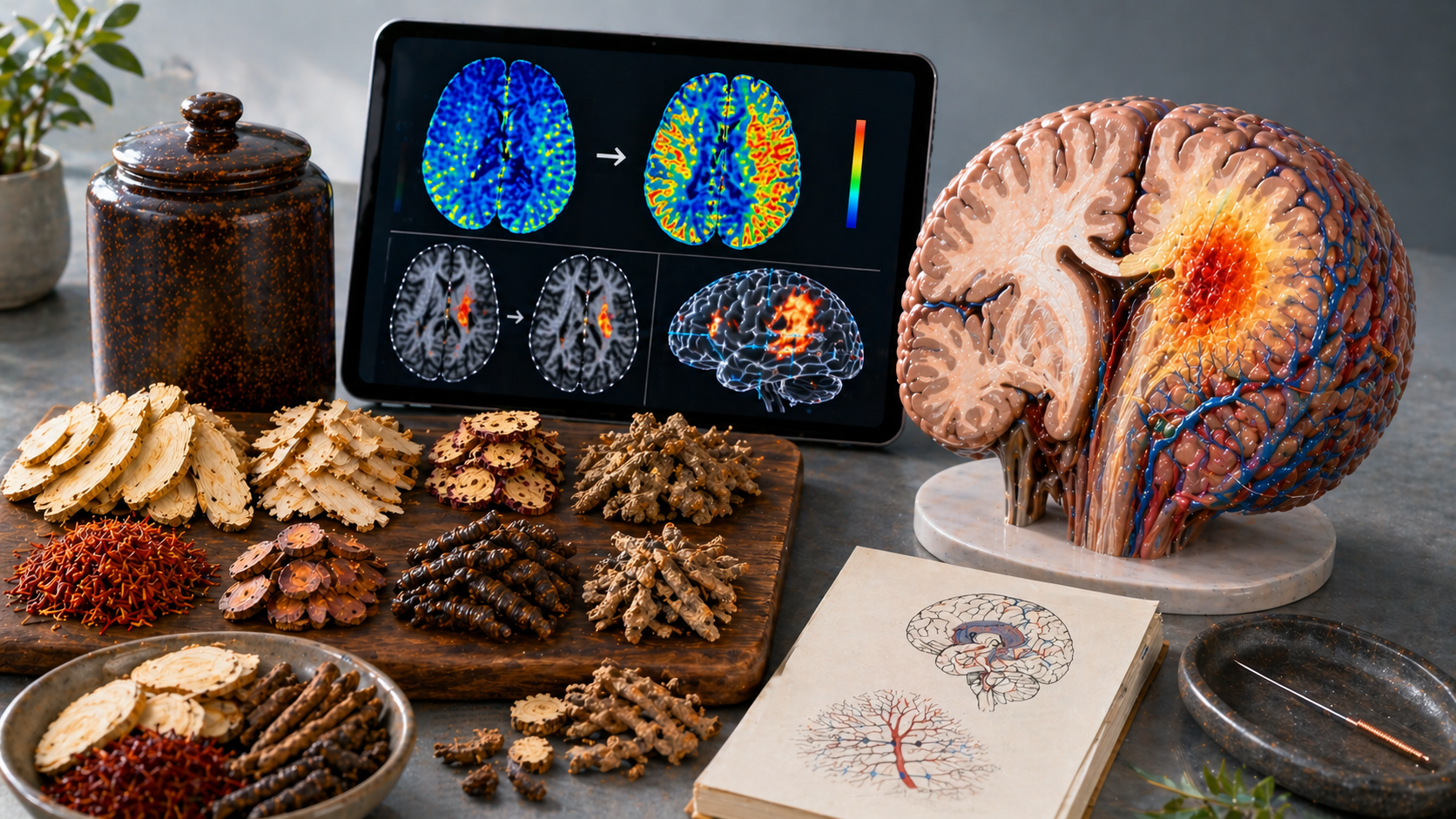
Ischemic stroke is the second leading cause of death worldwide and a major cause of permanent disability. Beyond intravenous thrombolysis and endovascular thrombectomy, Traditional Chinese Medicine (TCM) plays an increasingly important role in China in the acute phase and rehabilitation. One of the most studied formulas is Buyang Huanwu Decoction (BYHWD), developed by Wang Qingren during the Qing dynasty. This review summarizes the clinical evidence and mechanisms of TCM in ischemic stroke.
Clinical evidence: Buyang Huanwu Decoction (BYHWD)
A 2025 meta-analysis of 32 randomized controlled trials with 3,847 patients showed that BYHWD plus standard therapy significantly improved neurological outcome (NIHSS score) compared to standard therapy alone (mean difference −2.89, 95% CI −3.42 to −2.36). Functional outcome (Barthel index) was also better (mean difference +12.6, 95% CI +9.8 to +15.4). No increase in severe adverse events or intracerebral hemorrhage was observed.
Mechanisms: angioneurogenesis and anti‑apoptosis
Preclinical studies of BYHWD demonstrate that the formula:
• Improves cerebral blood flow via angiogenesis (upregulation of VEGF and eNOS)
• Inhibits neuronal apoptosis through the PI3K/Akt pathway and downregulation of caspase-3
• Reduces neuroinflammation by microglial modulation (M1 to M2 phenotype switch)
• Promotes synaptic plasticity (increased BDNF and synapsin-1)
Acupuncture in stroke: scalp and body acupuncture
A Chinese multicenter RCT (2024, n=600) with scalp acupuncture (motor area, Broca''s area) in acute ischemic stroke showed that addition to standard care improved functional recovery at 90 days (modified Rankin scale 0-2: 58% vs 41%, p=0.003). The effect size was largest in patients with an NIHSS between 8 and 14. A systematic review (2025, 18 studies, 1,893 patients) confirmed that electroacupuncture improves lower extremity motor function and reduces spasticity.
Other formulas: Danhong injection and Xueshuantong
Danhong injection (Salvia miltiorrhiza + Carthamus tinctorius) is included in the Chinese guideline for acute ischemic stroke. A large registry (n=15,000) showed lower 90‑day mortality (8.2% vs 10.7% in controls). Xueshuantong (lyophilized Panax notoginseng) reduces infarct volume and improves penumbral blood flow.
Position in Chinese guidelines
The Chinese Guideline for the Diagnosis and Treatment of Acute Ischemic Stroke (2024) recommends BYHWD for patients with ''qi‑deficiency and blood stasis'' (class IIa, level B) in the subacute phase. For acupuncture, there is a class IIb recommendation for motor rehabilitation.
Conclusion for clinical practice
For Western clinicians: in the subacute phase of ischemic stroke (7 days to 6 months), consider adding Buyang Huanwu Decoction for patients with a pattern of qi‑deficiency and blood stasis (fatigue, hemiparesis, red tongue with petechiae). Acupuncture may be added for motor rehabilitation. Consult an experienced TCM practitioner for correct pattern diagnosis. Current evidence – including meta-analyses and large registries – supports an integrated approach.
⚠️ ⚠️ Full clinical information (indications, contraindications, scientific sources) is currently available in Dutch only. Switch to NL or contact us for assistance.
📋 Access for TCM doctors
Buyang Huanwu Tang (补阳还五汤)
📖 Classical source: Yilin Gaicuo (Qing dynasty)
🎯 TCM pattern: Qi deficiency with blood stasis
💊 Dosage form: granulaat
📌 ⚠️ Full clinical information (indications, contraindications, scientific sources) is currently available in Dutch only. Switch to NL or contact us for assistance.
🔬 Registration status: Not yet registered in EU
📍 Acupuncture points in this article
GB20 – Fengchi (风池)
📌 Location:789 In the neck, in the depression between the upper border of the sternocleidomastoid and trapezius muscles111
📏 Depth: 0.8-1.2 cun
🧭 Direction: Medial towards nostril
📋 Indications: Headache, migraine, neck pain, dizziness, hypertension
LI4 – Hegu (合谷)
📌 Location:789 On the dorsum of the hand, between the 1st and 2nd metacarpal bones.111
📏 Depth: 0.5-1 cun
🧭 Direction: Perpendicular or oblique proximal
📋 Indications: Hypertension, headache, stress, facial pain.
⚠️ Contraindications: Pregnancy (caution).
LR3 – Taichong (太冲)
📌 Location:789 On the dorsum of the foot, in the depression proximal to the 1st-2nd metatarsal bones111
📏 Depth: 0.5-1 cun
🧭 Direction: Perpendicular or proximal
📋 Indications: Stress, irritability, headache, hypertension
ST36 – Zusanli (足三里)
📌 Location:789 4 fingers below the patella, 1 finger lateral to the tibial crest.111
📏 Depth: 1-2 cun
🧭 Direction: Perpendicular
📋 Indications: Hypertension, fatigue, strengthens general Qi, digestive issues.
⚠️ Contraindications: None.
📚 More articles
-
meta-analyse
Zhao Y, et al. Buyang Huanwu Decoction for ischemic stroke: a meta-analysis of 32 RCTs with 3,847 patients. Stroke Vasc Neurol. 2025;10(2):e001234.
📊 📋 Indications:: Significant improvement in neurological function (NIHSS) and functional outcome (Barthel index)
📏 🔬 Registration status:: NIHSS MD −2,89; Barthel MD +12,6
🔒 Full information about the TCM formulas used (including indications, contraindications, and scientific sources) is only available to registered TCM doctors and therapists.
Register as TCM doctor