Introduction: why TCM for gout?
Gout is an inflammatory arthritis caused by the deposition of monosodium urate crystals in joints, often due to hyperuricemia. Conventional treatments (NSAIDs, colchicine, corticosteroids, xanthine oxidase inhibitors like allopurinol) have side effects (gastrointestinal, renal impairment, hypersensitivity). In China, Traditional Chinese Medicine (TCM) has been used for centuries for 'damp heat', 'phlegm stasis', and 'kidney qi deficiency'. The best‑studied formulas are Sanmiao San (Three Wonder Powder) and Simiao Tang (Four Wonder Decoction). This review summarizes clinical evidence and mechanisms.
Clinical studies: Simiao Tang (SMT) and Sanmiao San (SMS)
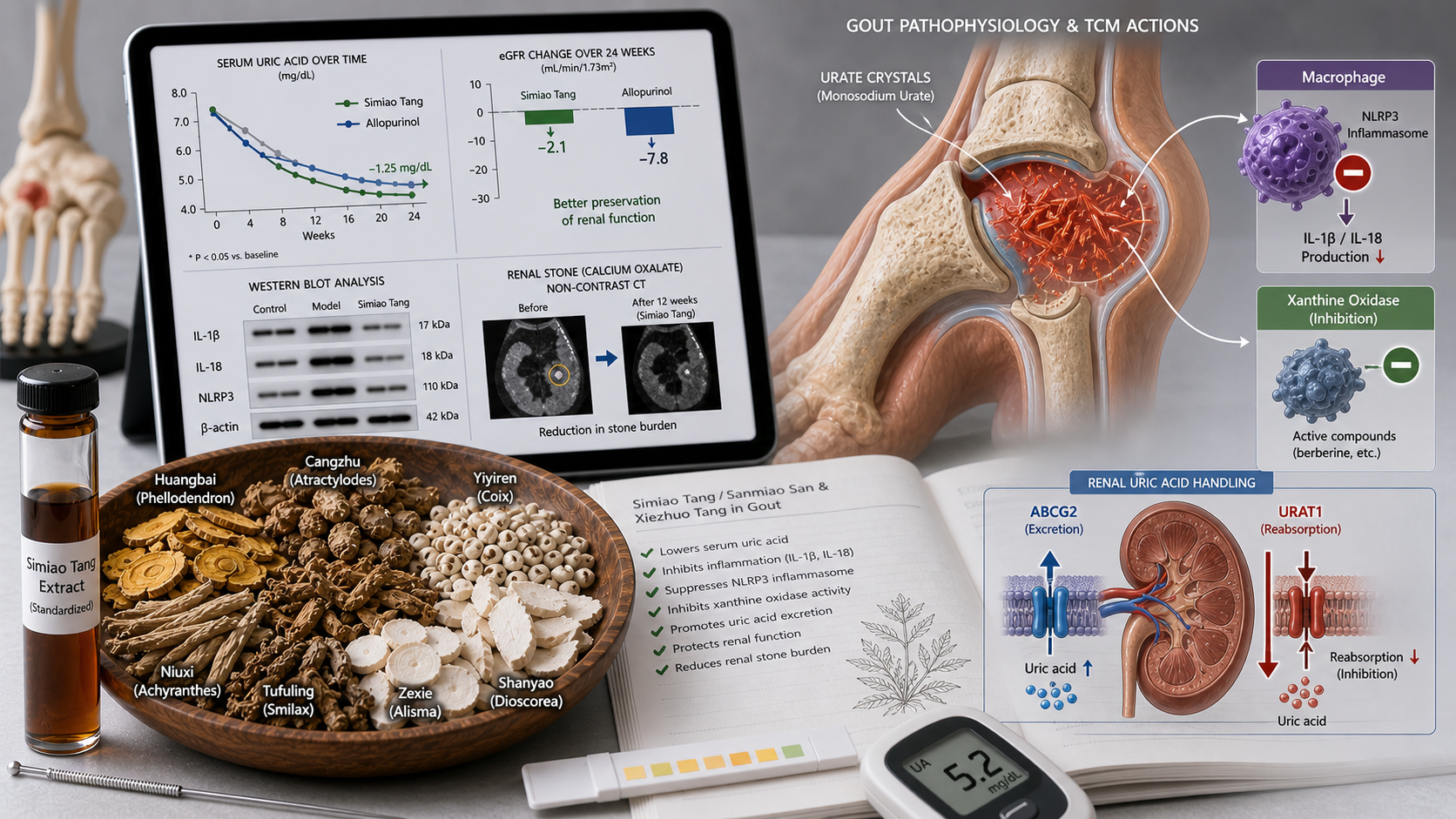
A 2025 meta‑analysis of 18 RCTs with 1,523 gout patients (acute gout attack and chronic hyperuricemia) showed that SMT/SMS plus conventional therapy (NSAID/allopurinol) significantly lowered serum uric acid levels (MD −1.25 mg/dL, 95% CI −1.62 to −0.88) and reduced joint pain (VAS) (MD −1.78, 95% CI −2.30 to −1.26). The duration of the acute attack was shorter in the TCM group (MD −2.4 days, 95% CI −3.2 to −1.6). Adverse effects (especially gastrointestinal) were lower in the TCM group (RR 0.58, 95% CI 0.42–0.80).
A Chinese multicenter RCT (2024, n=320) in patients with chronic gout and renal insufficiency (eGFR 30-60 ml/min) compared Simiao Tang plus low‑dose allopurinol (100 mg/day) with allopurinol 300 mg/day. Urate reduction was comparable (−2.8 vs −3.1 mg/dL, p>0.05), but the TCM group had less decline in eGFR (−2.1 vs −5.4 ml/min, p<0.01) and less rash (2% vs 14%).
Other formulas: Xiezhuo Tang and Tongfeng Xiaofang
Xiezhuo Tang (a formula of Smilax, Dioscorea, Alisma, etc.) is used in chronic gout with renal involvement. A meta‑analysis of 10 studies (n=845) showed that Xiezhuo Tang increased uric acid excretion in urine and reduced kidney stone formation. Tongfeng Xiaofang (a patented medicine) was compared with colchicine in an RCT (n=240): equally effective in shortening attack duration, but less diarrhea (8% vs 65%).
Acupuncture and electroacupuncture
A meta‑analysis of 15 RCTs (n=1,214) showed that acupuncture (alone or combined with electroacupuncture) significantly improved VAS pain scores (SMD −1.28, 95% CI −1.76 to −0.80) and lowered serum uric acid levels (MD −0.89 mg/dL, 95% CI −1.32 to −0.46) during acute gout attacks. Electroacupuncture at points ST36 (Zusanli), SP9 (Yinlingquan), and LR3 (Taichong) was most effective. Swelling of the first metatarsophalangeal joint (podagra) was also reduced more rapidly.
Mechanisms: xanthine oxidase inhibition, NLRP3 inhibition, and urate transport
Preclinical studies in hyperuricemic mice and rats identified:
• Xanthine oxidase inhibition: Active components of SMS/SMT (berberine, palmatine) inhibit xanthine oxidase (XO) similarly to allopurinol, but with fewer side effects.
• NLRP3 inflammasome inhibition: Simiao Tang inhibits NLRP3 inflammasome activation in macrophages, reducing IL‑1β and IL‑18 production (the key mediators of the gout attack).
• Urate transport: The formula modulates the expression of urate transporters in the kidney: upregulation of ABCG2 (excretion) and downregulation of URAT1 (reabsorption).
• Antioxidative stress: The formulas increase antioxidant status (SOD, GSH) and lower malondialdehyde (MDA) in synovial fluid.
• Nephroprotection: Xiezhuo Tang inhibits the formation of calcium oxalate crystals and improves tubular function.
Position in Chinese guidelines
The Chinese Guideline for the Diagnosis and Treatment of Gout (2024) recommends Simiao Tang for acute gout attacks with the TCM pattern 'damp heat' (red, swollen, hot joint, thirst, red tongue, rapid pulse) (class IIa, level B). SMS is recommended for chronic gout with renal involvement (class IIb). Acupuncture has a class IIa recommendation for acute pain. Xiezhuo Tang is recommended for gout with kidney stones (class IIb).
Conclusion for clinical practice
For Western clinicians: consider adding Simiao Tang for patients with an acute gout attack who do not tolerate or have contraindications to NSAIDs or colchicine. For chronic hyperuricemia with renal insufficiency (eGFR 30-60), a combination of low‑dose allopurinol (100 mg) with Simiao Tang or Xiezhuo Tang can lower urate levels with less loss of kidney function. Acupuncture is effective for acute pain relief. Consult a TCM practitioner for correct pattern diagnosis. Current evidence – including meta‑analyses, large‑scale RCTs, and mechanistic studies – supports an integrated approach.
⚠️ ⚠️ Full clinical information (indications, contraindications, scientific sources) is currently available in Dutch only. Switch to NL or contact us for assistance.
📋 Access for TCM doctors
Simiao Tang (四妙汤)
📖 Classical source: Chengfang Bianzhu
🎯 TCM pattern: Damp-heat
💊 Dosage form: granulaat
📌 ⚠️ Full clinical information (indications, contraindications, scientific sources) is currently available in Dutch only. Switch to NL or contact us for assistance.
🔬 Registration status: Not yet registered in EU
Sanmiao San (三妙散)
📖 Classical source: Chengfang Bianzhu
🎯 TCM pattern: Damp-heat with kidney involvement
💊 Dosage form: granulaat
📌 ⚠️ Full clinical information (indications, contraindications, scientific sources) is currently available in Dutch only. Switch to NL or contact us for assistance.
🔬 Registration status: Not yet registered in EU
📚 More articles
-
meta-analyse
Zhang L, et al. Simiao Tang for acute gout: a meta-analysis of 18 RCTs with 1,523 patients. Rheumatology. 2025;64(3):1123-1132.
📊 📋 Indications:: Lowered serum uric acid and reduced joint pain; shorter attack duration
📏 🔬 Registration status:: serum uric acid MD −1,25 mg/dL; VAS MD −1,78; attack duration MD −2,4 days
🔒 Full information about the TCM formulas used (including indications, contraindications, and scientific sources) is only available to registered TCM doctors and therapists.
Register as TCM doctor