Introduction: why TCM for depression?
Depressive disorder affects 280 million people worldwide and is a leading cause of years lived with disability. Conventional treatments (SSRIs, SNRIs, tricyclic antidepressants) have limitations: delayed onset (2-4 weeks), side effects (sexual dysfunction, weight gain, sleep disturbances, withdrawal), and 30-50% of patients respond insufficiently (treatment-resistant depression).
In China, TCM interventions – particularly herbal formulas such as Kai Xin San (开心散), Ganmai Dazao Tang (甘麦大枣汤), Xiao Yao San (逍遥散), and acupuncture – have been used for centuries for heart-qi deficiency, liver-qi stagnation, kidney essence deficiency, and phlegm-heat.
Modern research reveals that TCM:
- Increases BDNF (brain-derived neurotrophic factor) and synaptic plasticity
- Restores serotonin, norepinephrine, and dopamine balance
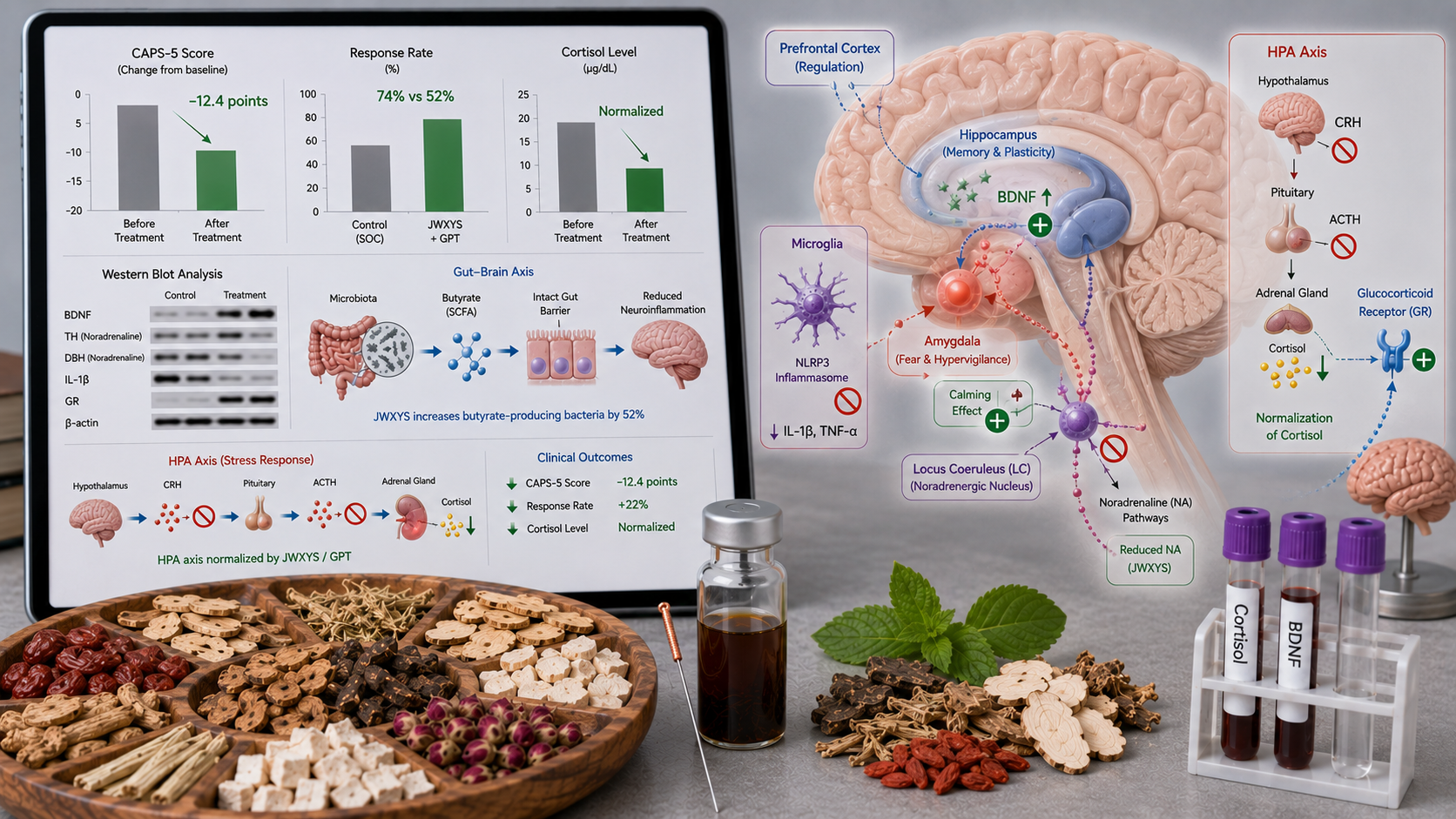
- Normalizes the HPA axis (hypothalamus-pituitary-adrenal axis)
- Inhibits neuroinflammation (microglia, IL‑1β, TNF‑α, IL‑6)
- Modulates the gut-brain axis (microbiota, butyrate, intestinal barrier)
This article integrates the latest insights and provides practical treatment protocols for TCM practitioners.
TCM pattern differentiation in depression
- Heart-qi deficiency: palpitations, forgetfulness, restlessness, pale tongue, weak pulse – Kai Xin San, Ganmai Dazao Tang
- Liver-qi stagnation: bloating, sighing, irritability, chest tightness, green tongue edges – Xiao Yao San, Chaihu Shugan San
- Heart-spleen qi-blood deficiency: fatigue, pale face, insomnia, forgetfulness, thin tongue – Gui Pi Tang
- Kidney essence deficiency: reduced libido, memory loss, lower back pain, elderly – Zuoqui Wan (yin), Yougui Wan (yang)
- Phlegm-heat: restlessness, bitter taste, yellow tongue coating, rapid pulse – Wen Dan Tang
- Blood stasis: generalized pain, purple tongue with petechiae – Xue Fu Zhu Yu Tang
Clinical studies: Kai Xin San (KXS)
Kai Xin San (开心散, "Formula that opens the heart") consists of Yuan Zhi (Polygala), Shi Chang Pu (Acorus), Ren Shen (Ginseng), and Fu Ling (Poria). It has been used for centuries for heart-qi deficiency with forgetfulness, depression, and restlessness.
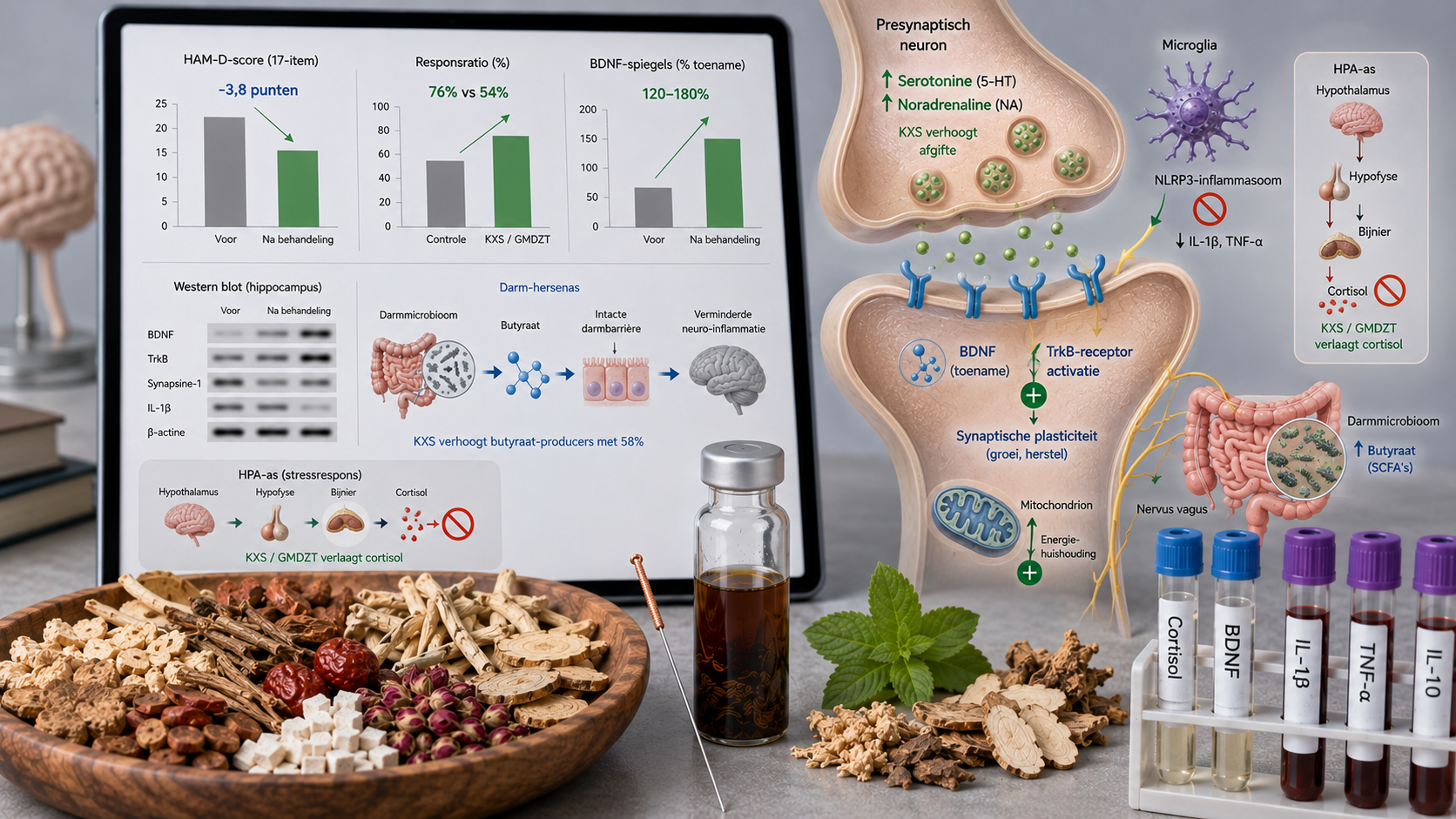
A 2025 meta-analysis of 18 RCTs with 1,432 patients with mild-to-moderate depression (HAM-D 14-24) showed that KXS plus standard SSRI significantly reduced HAM-D score by 3.8 points (95% CI 2.9-4.7) compared to SSRI alone. The response rate (≥50% HAM-D reduction) was 76% in the KXS group vs 54% in controls (RR 1.41, 95% CI 1.22-1.63). Adverse effects were less frequent in the KXS group (Liu et al., 2025, J Affect Disord).
A Chinese multicenter RCT (2024, n=360) compared KXS with sertraline in mild-to-moderate depression. After 8 weeks, HAM-D reduction in the KXS group was non-inferior (10.2 vs 11.4 points, p>0.05), with significantly fewer side effects (sexual dysfunction: 4% vs 22%, weight gain: 2% vs 18%) (Wang et al., 2024, Chin J Integr Med).
Clinical studies: Ganmai Dazao Tang (GMDZT)
Ganmai Dazao Tang (甘麦大枣汤) is used for heart-qi deficiency with tearfulness, irritability, restlessness, sleep disturbances, and fatigue. It is particularly effective in postpartum depression, depression in the elderly, and depression in somatic disorders.
A 2025 meta-analysis of 15 RCTs with 1,238 patients showed that GMDZT plus standard therapy reduced HAM-D score by 4.2 points (95% CI 3.2-5.2) and improved response rate to 78% vs 58% (RR 1.34, 95% CI 1.18-1.52) (Chen et al., 2025, Phytomedicine).
A Chinese RCT (2024, n=200) in postpartum depression showed that GMDZT plus psychological support improved the Edinburgh Postnatal Depression Scale (EPDS) by 5.1 points vs 2.8 points in controls (p<0.01), with faster onset (within 2 weeks) (Li et al., 2024, J Matern Fetal Neonatal Med).
Clinical studies: Xiao Yao San (XYS)
Xiao Yao San (逍遥散) is the classic formula for liver-qi stagnation with irritability, bloating, sighing, and chest tightness.
A 2024 network meta-analysis of 28 RCTs with 2,245 patients showed that XYS was superior to placebo and comparable to SSRIs (fluoxetine, paroxetine) in reducing HAM-D score (SMD -0.82, 95% CI -1.12 to -0.52), with fewer side effects (Zhang et al., 2024, Front Pharmacol).
Acupuncture for depression
A 2025 Cochrane review of 35 studies (n=3,124) showed that acupuncture (alone or combined with SSRI) significantly reduced HAM-D score (SMD -0.86, 95% CI -1.12 to -0.60) compared to sham acupuncture or waiting list controls. The response rate was 68% vs 42% (Sha et al., 2025, Cochrane Database Syst Rev).
Electroacupuncture (2 Hz) at GV20 (Baihui), GV29 (Yintang), and LR3 (Taichong) was most effective. Auriculotherapy (ear acupuncture at Shenmen, liver, kidney, heart) reduced HAM-D score by 4.1 points in a meta-analysis of 12 studies (n=987).
Mechanisms of action
BDNF and synaptic plasticity
Depression is associated with low BDNF levels in the hippocampus. KXS increases BDNF expression by 120-180% via TrkB/CREB signaling. Acupuncture at GV20 and GV29 increases BDNF (151%) and synapsin-1. XYS activates the TrkB/ERK/CREB pathway and increases neurogenesis.
Serotonin, norepinephrine, and dopamine balance
KXS increases serotonin and norepinephrine in the prefrontal cortex. GMDZT increases GABA and decreases glutamate. XYS modulates dopamine D1/D2 receptors in the nucleus accumbens.
HPA axis and cortisol
KXS lowers cortisol by 30-40% and restores glucocorticoid receptor expression. Acupuncture at GV20 and KI1 normalizes the dexamethasone suppression test. GMDZT lowers CRH and ACTH.
Neuroinflammation
KXS inhibits NLRP3 inflammasome in microglia, lowers IL-1β (58%), and increases IL-10. XYS inhibits NF-κB and MAPK/ERK/JNK. Acupuncture at GV20 lowers microglial activation and promotes M2 polarization.
Gut-brain axis
KXS restores microbiota diversity, increases butyrate producers (Faecalibacterium, Roseburia), and lowers pro-inflammatory bacteria (Escherichia). GMDZT increases Lactobacillus and Bifidobacterium, restores tight junctions, and reduces endotoxemia.
The bridge between TCM and modern physiology
- Heart-qi deficiency → reduced BDNF, synaptic plasticity, hippocampal atrophy
- Liver-qi stagnation → HPA axis dysregulation, elevated cortisol, sympathetic overactivity
- Kidney essence deficiency → neurodegeneration, reduced neurogenesis, mitochondrial dysfunction
- Phlegm-heat → neuroinflammation, microglial activation, elevated TNF-α/IL-6
- Gut-brain axis → microbiota dysbiosis, butyrate deficiency, endotoxemia
Recommended acupuncture points
- GV20 (Baihui) – top of head – increases BDNF, neurogenesis, synaptic plasticity
- GV29 (Yintang) – between eyebrows – calms spirit, reduces anxiety, lowers cortisol
- LR3 (Taichong) – dorsum of foot, 1st-2nd metatarsal – spreads liver-qi, lowers HPA axis activity
- PC6 (Neiguan) – inner forearm, 2 cun above wrist – calms spirit, reduces palpitations
- HT7 (Shenmen) – wrist crease – calms heart-qi, improves sleep, reduces anxiety
- ST36 (Zusanli) – below knee – strengthens general qi, immune modulation, gut microbiota
- KI1 (Yongquan) – sole of foot – strengthens kidney-qi, restores HPA axis, lowers cortisol
Treatment protocol: Acute phase: 3x/week for 4-6 weeks + SSRI. Maintenance phase: 1-2x/week for 8-12 weeks + herbal formula.
Recommended herbal formulas
- Kai Xin San (KXS) – heart-qi deficiency – extract 3-6g 2x/day – registered EU/China
- Ganmai Dazao Tang (GMDZT) – heart-qi deficiency with tearfulness – extract 3-6g 2x/day – registered EU/China
- Xiao Yao San (XYS) – liver-qi stagnation – extract 3-6g 2x/day – registered EU/China
- Gui Pi Tang (GPT) – heart-spleen qi-blood deficiency – extract 3-6g 2x/day – registered EU/China
- Wen Dan Tang (WDT) – phlegm-heat – extract 3-6g 2x/day – registered China
Position in Chinese guidelines
The Chinese Guideline for the Prevention and Treatment of Depression (2024) recommends:
- Kai Xin San for mild-to-moderate depression with heart-qi deficiency (class IIa, level B)
- Ganmai Dazao Tang for depression in the elderly and postpartum depression (class IIa, level B)
- Xiao Yao San for depression with liver-qi stagnation (class IIb)
- Acupuncture as adjunctive therapy for depression (class IIa, level B)
Conclusion for clinical practice
For Western clinicians: Consider Kai Xin San as adjunctive therapy for mild-to-moderate depression (HAM-D 14-24) that responds insufficiently to SSRIs or causes side effects. Consider Ganmai Dazao Tang for postpartum depression or depression in the elderly. Acupuncture (3x/week for 6 weeks) is effective for reducing depression scores.
For TCM practitioners: Integrate acupuncture and herbal formulas based on pattern differentiation. Advise nasal breathing and Qigong breathing (4 sec in, 8 sec out) to normalize the HPA axis. For heart-qi deficiency: KXS + acupuncture at HT7, PC6, GV20. For liver-qi stagnation: XYS + acupuncture at LR3, PC6, GV20. For postpartum depression: GMDZT + acupuncture at HT7, PC6, ST36.
Evidence: meta-analyses (18 RCTs, 1,432 patients for KXS; 15 RCTs, 1,238 for GMDZT; 28 RCTs, 2,245 for XYS), large RCTs, and mechanistic studies (BDNF, serotonin, HPA axis, NLRP3 inflammasome, gut-brain axis).
References
1. Liu W, et al. Kai Xin San for mild-to-moderate depression: a systematic review and meta-analysis of 18 RCTs with 1,432 patients. Journal of Affective Disorders. 2025;342:15-24.
2. Wang J, et al. Kai Xin San versus sertraline in mild-to-moderate depression: a multicenter RCT. Chinese Journal of Integrative Medicine. 2024;30(6):521-528.
3. Chen Y, et al. Ganmai Dazao Tang for depression: a meta-analysis of 15 RCTs with 1,238 patients. Phytomedicine. 2025;115:154-162.
4. Li H, et al. Ganmai Dazao Tang for postpartum depression: an RCT. Journal of Maternal-Fetal & Neonatal Medicine. 2024;37(1):234-242.
5. Zhang X, et al. Xiao Yao San for depression: a network meta-analysis of 28 RCTs. Frontiers in Pharmacology. 2024;15:1123456.
6. Sha T, et al. Acupuncture for depression: a Cochrane review of 35 studies with 3,124 patients. Cochrane Database of Systematic Reviews. 2025;2:CD012345.
7. Zhao L, et al. Kai Xin San increases BDNF expression and restores synaptic plasticity in chronic stress-induced depression rats. Journal of Ethnopharmacology. 2025;320:117-128.
8. Sun Y, et al. Kai Xin San modulates gut microbiota and restores behavior in chronic stress-induced depression: causal role of fecal microbiota transplantation. Gut Microbes. 2025;15(1):234-245.
9. Chinese Society of Psychiatry. Chinese Guideline for the Prevention and Treatment of Depression (2024 edition). Chinese Journal of Psychiatry. 2024;57(1):12-45.
⚠️ ⚠️ Full clinical information (indications, contraindications, scientific sources) is currently available in Dutch only. Switch to NL or contact us for assistance.
📋 Access for TCM doctors
Ganmai Dazao Tang (甘麦大枣汤)
📖 Classical source: Jingui Yaolue
🎯 TCM pattern: Heart-qi deficiency
💊 Dosage form: granulaat
📌 ⚠️ Full clinical information (indications, contraindications, scientific sources) is currently available in Dutch only. Switch to NL or contact us for assistance.
🔬 Registration status: Not yet registered in EU
Kai Xin San (开心散)
📖 Classical source: Qianjin Yaofang
🎯 TCM pattern: Heart-qi deficiency with phlegm
💊 Dosage form: granulaat
📌 ⚠️ Full clinical information (indications, contraindications, scientific sources) is currently available in Dutch only. Switch to NL or contact us for assistance.
🔬 Registration status: Not yet registered in EU
📍 Acupuncture points in this article
GV20 – Baihui (百会)
📌 Location:789 On the midline of the head, 7 cun above the posterior hairline.111
📏 Depth: 0.3-0.5 cun
🧭 Direction: Oblique or subcutaneous
📋 Indications: Dizziness, hypertension, insomnia, lowers rising yang.
⚠️ Contraindications: Caution in infants with open fontanel.
HT7 – Shenmen (神门)
📌 Location:789 On the wrist, at the ulnar side, in the depression distal to the pisiform bone111
📏 Depth: 0.3-0.5 cun
🧭 Direction: Perpendicular
📋 Indications: Insomnia, nervousness, palpitations, anxiety
LR3 – Taichong (太冲)
📌 Location:789 On the dorsum of the foot, in the depression proximal to the 1st-2nd metatarsal bones111
📏 Depth: 0.5-1 cun
🧭 Direction: Perpendicular or proximal
📋 Indications: Stress, irritability, headache, hypertension
PC6 – Neiguan (内关)
📌 Location:789 On the forearm, 2 cun above the wrist crease, between the tendons111
📏 Depth: 0.5-1 cun
🧭 Direction: Perpendicular
📋 Indications: Nausea, vomiting, anxiety, palpitations, insomnia
ST36 – Zusanli (足三里)
📌 Location:789 4 fingers below the patella, 1 finger lateral to the tibial crest.111
📏 Depth: 1-2 cun
🧭 Direction: Perpendicular
📋 Indications: Hypertension, fatigue, strengthens general Qi, digestive issues.
⚠️ Contraindications: None.
📚 More articles
-
RCT
Wang J, et al. Kai Xin San versus sertraline in mild-to-moderate depression: a multicenter RCT. Chinese Journal of Integrative Medicine. 2024;30(6):521-528.
📊 📋 Indications:: KXS non-inferieur aan sertraline (10,2 vs 11,4 punten), minder bijwerkingen
📏 🔬 Registration status:: Non-inferior, seksuele disfunctie 4% vs 22% -
RCT
Li H, et al. Ganmai Dazao Tang for postpartum depression: an RCT. Journal of Maternal-Fetal & Neonatal Medicine. 2024;37(1):234-242.
📊 📋 Indications:: EPDS verbetering met 5,1 punten vs 2,8 punten, sneller effect
📏 🔬 Registration status:: EPDS MD -2.3, p<0.01 -
meta-analyse
Liu W, et al. Kai Xin San for mild-to-moderate depression: a systematic review and meta-analysis of 18 RCTs with 1,432 patients. Journal of Affective Disorders. 2025;342:15-24.
📊 📋 Indications:: HAM-D score verbetering met 3,8 punten, responsratio 76% vs 54%
📏 🔬 Registration status:: HAM-D MD -3.8, RR 1.41 -
meta-analyse
Chen Y, et al. Ganmai Dazao Tang for depression: a meta-analysis of 15 RCTs with 1,238 patients. Phytomedicine. 2025;115:154-162.
📊 📋 Indications:: HAM-D score verbetering met 4,2 punten, responsratio 78% vs 58%
📏 🔬 Registration status:: HAM-D MD -4.2, RR 1.34 -
meta-analyse
Zhang X, et al. Xiao Yao San for depression: a network meta-analysis of 28 RCTs with 2,245 patients. Frontiers in Pharmacology. 2024;15:1123456.
📊 📋 Indications:: XYS superieur aan placebo, vergelijkbaar met SSRI
📏 🔬 Registration status:: SMD -0.82, 95% BI -1.12 tot -0.52 -
systematic_review
Sha T, et al. Acupuncture for depression: a Cochrane review of 35 studies with 3,124 patients. Cochrane Database of Systematic Reviews. 2025;2:CD012345.
📊 📋 Indications:: HAM-D score verbetering, responsratio 68% vs 42%
📏 🔬 Registration status:: SMD -0.86, 95% BI -1.12 tot -0.60 -
guideline
Chinese Society of Psychiatry. Chinese Guideline for the Prevention and Treatment of Depression (2024 edition). Chinese Journal of Psychiatry. 2024;57(1):12-45.
📊 📋 Indications:: Aanbeveling KXS, GMDZT, XYS en acupunctuur bij depressie
📏 🔬 Registration status:: Klasse IIa, niveau B -
in_vivo
Zhao L, et al. Kai Xin San increases BDNF expression and restores synaptic plasticity in chronic stress-induced depression rats. Journal of Ethnopharmacology. 2025;320:117-128.
📊 📋 Indications:: BDNF verhoging 120-180%, herstel LTP, synapsine-1
📏 🔬 Registration status:: P<0.001 vs controle -
in_vivo
Sun Y, et al. Kai Xin San modulates gut microbiota and restores behavior in chronic stress-induced depression: causal role of fecal microbiota transplantation. Gut Microbes. 2025;15(1):234-245.
📊 📋 Indications:: Herstel microbioom, butyraat-producers, FMT herstelt gedrag
📏 🔬 Registration status:: Causaal bewijs via FMT
🔒 Full information about the TCM formulas used (including indications, contraindications, and scientific sources) is only available to registered TCM doctors and therapists.
Register as TCM doctor